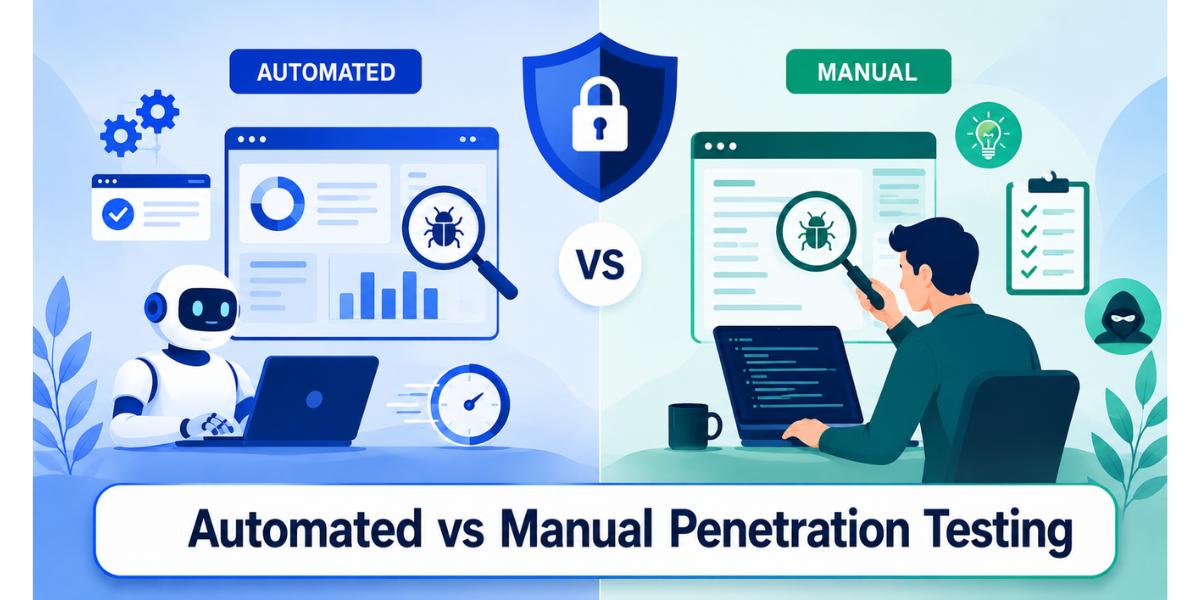
Automated vs Manual Penetration Testing Solutions: A Plain Comparison
Organizations that are looking to for penetration testing solutions done are presented with two tempting choices: Automated tools that are faster and, well, automatic with minimal human intervention or a deeper test that is backed by human expertise.
Both choices are portals to a completely different dimension of the security assessment. Each penetration testing solution operates at its own rhythm, pace and expense.
Organizations cannot afford to make the wrong decision, as two different approaches can lead to two different outcomes. Hence, being educated on automated and manual penetration testing and weighing their pros and cons is a must.
Let’s first understand what penetration testing is in the first place. By definition, it refers to a controlled cybersecurity exercise that is built to identify underlying weaknesses in the digital infrastructure of a company by simulating real-world attack scenarios.
Unlike traditional security assessments, penetration testing is proactive in character and actively hunts for threats instead of waiting for them to get converted into breaches.
Penetration testing follows two broad methodologies: Automated penetration testing and manual penetration testing. Though they have the same purpose, they can drive significantly different results.
Defining Automated and Manual Penetration Testing Solutions
Automated penetration testing performs predefined testing objectives to scan systems, applications and infrastructure for vulnerabilities and inconsistencies.
This testing can cover large environments with speed and limited human intervention. Since the process is automated, testing can be conducted continuously or more frequently.
Automated testing is only good as the knowledge and skills transferred into the tools. Any situational weakness may go undetected by automated tools, as it operates with pre fed knowledge and lacks contextual interpretation.
Manual penetration testing solutions involves skilled security experts that attempt real-world cyberattacks to look for loopholes and assess overall exploitability of the digital infrastructure.
Instead of adhering to a predefined routine, manual testers improvise attack routes as new weaknesses emerge along the way.
Manual testing includes authentication and access controls, social engineering attacks and primarily exploitation of complex or interlinked pathways.
Although this approach delivers deeper insights, it is expensive and time consuming.
Key Differences Between Automated and Manual Penetration Testing Solutions
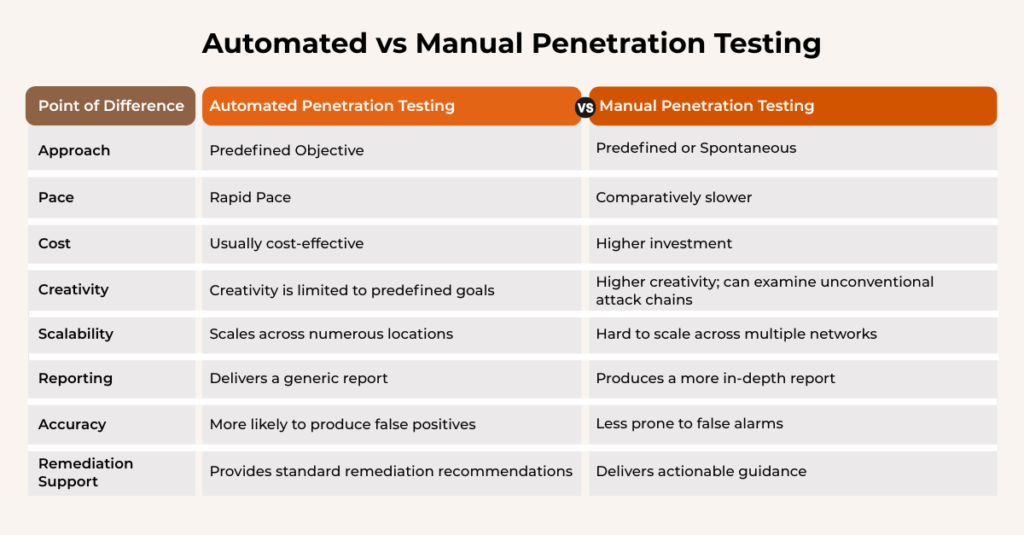
The Pros and Cons List: Automated Penetration Testing vs Manual Penetration Testing
Each method has its own winning and losing points. To make things easier, below is a pros and cons list to help you understand the distinction between the two approaches:
Pros of Automated Penetration Testing
- Rapid Assessment Outcome: One of the core features of automated testing is its fast pace. Through automated testing, you can scan multiple assets, applications, APIs and endpoints rapidly.
- Cost-effective: Automated testing has a lesser operational cost due to the minimal need of human resources to execute assessments. Once trained well, tests can operate with limited intervention, which saves costs for allocating expert teams for every assessment.
- Consistent Testing Approach: Automation follows predefined rules and approach, which eliminates the chance of any creative testing methodology. This approach works well for fulfilling compliance requirements or security protocols within the company.
- Scaling Across Large Environments: Automated testing can efficiently scale complex ecosystems like cloud accounts, applications and other interlinked systems without prominent execution effort.
- Provides Continuous Supervision: Automated testing supports continuous monitoring and immediately notifies the security team, in case of any kind of inconsistent behaviour in the system.
Cons of Automated Penetration Testing
- Limited to Defined Attack Pathways: Automated testing sticks to the predefined plan, which can neglect unexpected vulnerabilities that exist off the targeted surface.
- Prone to False Positives: Automated assessments are more prone to false positives. This can cause unnecessary disturbance in security operations and alert fatigue.
- Less Contextual Understanding: Automated testing relies on technical indicators to test the system but may overlook business priorities or acceptable risk levels.
- Cannot Fully Replicate Attacker Behaviour: Automated systems are not as creative and spontaneous as real attackers. Real attackers also possess the tendency to target and combine multiple weaknesses, and automated testing typically tests systems in phases instead of testing multiple stages together.
Pros of Manual Penetration Testing
- Reveals Complex Vulnerabilities: Manual penetration testing solutions dig deeper into the system and is capable of recognising interconnected or complex issues, that may have bypassed automated testing.
- Embodies Real Attacker Mindset: Manual penetration testing experts think and act like a real attacker while penetrating the system. This allows for improvised testing rather than a predefined rigid assessment.
- Higher Accuracy in Penetration Operations: Since revelations are backed and verified by a team of specialists, manual penetration testing delivers increased accuracy in operations.
- Understanding of Business Context: Manual penetration testing combines technology with business standpoint. It boosts customer experience, financial exposure and business continuity along with security.
- Detailed Remediation Recommendations: Instead of a vague report, manual testing tailors actionable and detailed remediation guidance with an explanation on root causes, attack paths and business impact.
Cons of Manual Penetration Testing
- Higher Cost and Resource Requirements: Manual testing includes a team of skilled security professionals. Extensive time, expertise and effort, goes into executing the assessment, which leads to higher operational costs.
- Longer Execution Timelines: Manual testing is more time consuming than an automated assessment, as they go deeper to analyse ecosystems, investigate insights and check exploitability.
- Limited Scalability: It is challenging to expand testing coverage across large environments immediately. Scaling further requires increased personnel, costs and resources.
- Results Vary with Testers: Since the core of manual penetration testing is human expertise, results can vary depending on the tester’s skill, approach and experience. Different teams testing the same environment may declare different outcomes.
Conclusion: What Smart Organizations Are Choosing
Automated and manual penetration testing solutions are not two competing forces. They solve the same problem with different ideologies.
The answer is straightforward. If your priorities are continuous monitoring, speed and scalability, automated testing wins, but if your focus is depth, creativity and human expertise, manual penetration testing is your solution.
Organizations that smartly leverage the best of both worlds and curate a personalised strategy that works for their system security, thrive in the long run. An even smarter approach is partnering with competent VAPT providers like CyberNX, who provide tailored strategies by understanding your organization’s needs and provide a customised penetration testing solution that will push your system’s security to the next level.