30% Hardware Cost Reduction: How Engineers Avoid Pitfalls in Custom Sheet Metal Enclosures
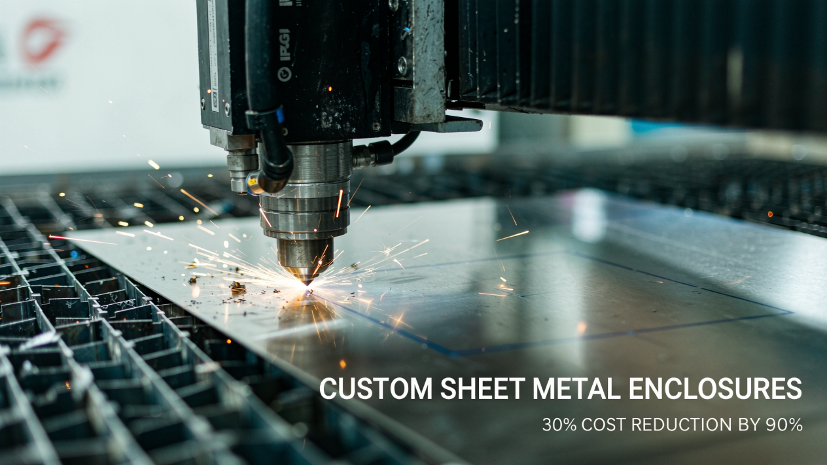
Figure 1: Advanced fiber laser cutting technology enables the precise fabrication of custom sheet metal enclosures, ensuring high accuracy while significantly reducing production costs.
Introduction
Electronic hardware engineers regularly encounter cost overruns exceeding 30% when making prototypes for custom sheet metal enclosures. This is largely due to improper tolerance settings, inadequate bend radii, and excessive material loss. Though, if the team applies DFM optimizations from the very beginning, finds a laser cutting compatible with a CNC bending processes, and chooses the right processing partners with international quality certifications, they can greatly reduce the R&D time as well as the mass production cost while still keeping the shielding and thermal performance features.
Why Do Electronic Enclosure Designs Fail During Rapid Prototyping?
Metal enclosures typically have problems with assembly interference, misplaced ventilation holes, and sheet deformation when rapid prototyping & low-volume production is done by the user. Issues mainly come from DFM review being insufficient at the design stage.
Common Design Oversights in Early Prototypes
Engineers frequently miss important elements like accounting for material springback, setting a limit on minimum bend radius, and maintaining required hole-to-edge distance. For example, a custom aluminum enclosure design specifying an inside bend of 0.5 mm on 2 mm thick 5052 aluminum will eventually crack or distort, which is a well-known fact. Then again, drilling mounting holes that are too close to the bend lines will cause deformation and misalignment.
The DFM Review Solution
Conducting a structured DFM review before the drawings fabrication release is a good practice to detect those problems at the earliest stage. Main checking points are:
- Minimum bend radius: For aluminum 1X or more material thickness.
- Hole clearance: 3X material thickness should be kept at least from bending lines.
- Cutting at corners: Relief cuts have to be added before cutting at intersecting bending to prevent tearing.
These preventive measures guarantee prototyping first-pass success thereby not having to go through expensive rework cycles.
How Can Engineers Optimize Laser Cutting and CNC Bending Tolerances?
Precision in matching up the laser-cut features to the CNC bent surfaces depends on knowing the tolerance compensation process between two processes.
Fiber Laser Cutting Precision
Fiber laser cutting technology cuts with kerf widths of 0.1-0.2 mm with positional accuracy of ±0.05mm. It results in very little heat-affected zone, leaving the edges in good condition for bending. However, engineers need to consider:
- Location of pierce points: Locate pierce points outside critical areas.
- Material utilization: Nest parts efficiently while considering the grain orientation.
- Burrs heights: State whether burrs removal is required.
CNC Bending Compensation Strategies
A CNC servo press brake with angle encoder can guarantee a repeatability up to ±0.3°. The springback compensation, which is usually 2–5°, is a function that has to be programmed into the bending step based on the grade and thickness of the material. To avoid exceeding dimensional tolerances on complex multi-bend enclosures using a step by step method with periodic checks helps keep the overall errors within acceptable limits.
When deciding which china sheet metal manufacturer to select to get consistent quality across all your orders of complex electronic hardware, the engineers need to look into a manufacturer’s precision capabilities.
Precision sheet metal manufacturing is achieved by combining the techniques with a stringent process control system. Custom sheet metal services companies with their own laser cutting and CNC bending services can avoid cumulative errors that might arise from dealing with multiple suppliers.
What Structural Design Factors Directly Impact Sheet Metal Fabrication Cost?
Three main factors that influence sheet metal fabrication cost are the way material is used, how often the tools are reused, and whether the surface finishing is complicated.
Material Utilization and Nesting Efficiency
The major factor in sheet metal cost is the raw material itself. The part nesting optimization on large standard sheets like 4′ × 8′ can boost material utilization from 60% to 85% which in turn lowers per-item cost.
Bend Radius Standardization and Surface Treatment
Using just one or two types of bend radii (like R1.5 mm and R3 mm), eliminates the switching of tools, which can reduce setup time up to 30-40%. In case of metal enclosure fabrication, it is the balancing act of optimizing ventilation hole patterns that enables good thermal performance and saves on machining time.
Hardware structural thermal management requirements are often a cause of unexpected costs. If external anodizing is limited to external surfaces only, you can save 20% on finishing costs compared with full immersion anodizing. Through optimization of bend radius and hole clearances teams are able to bring down total costs when employing a specialist sheet metal fabrication service for custom enclosures.
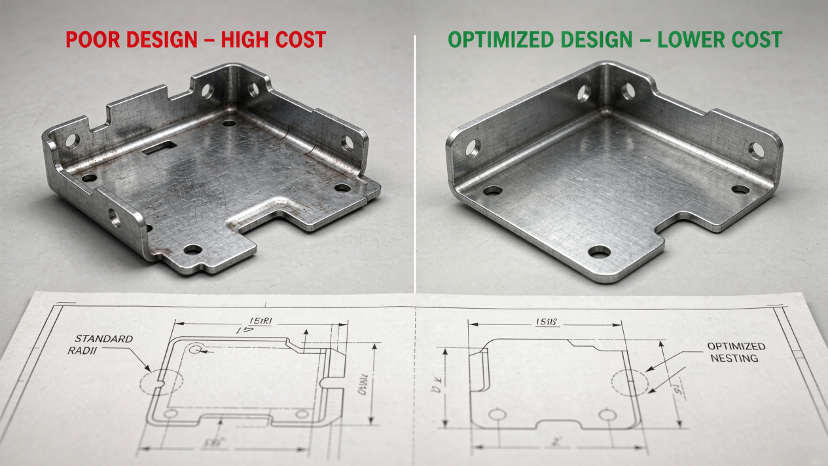
Figure 2: DFM optimization transforms inefficient, high-cost sheet metal designs into streamlined, cost-effective components without compromising structural integrity.
How Do Certified Quality Standards Prevent Hardware Defect Risks?
Quality management systems are the guarantee of the same characteristics for each production batch. In manufacturing industry and commercial precision manufacturing, reliable and recognized quality assurance can only be based on authoritative certifications. LS Manufacturing is the manufacturer that has all comprehensive certifications: ISO 9001, ISO 14001, IATF 16949, AS9100D.
Quality management systems based on such standards set certain requirements:
- Verification of raw materials: Spectrometer analysis of the alloys.
- Intermediate inspection: First-article and in-process dimensional control.
- Quality control gate: Critical features measuring via CMM.
For ISO certified metal manufacturers these procedures avoid common defects like burrs scratches coating adhesion problems that usually sheet metal fabrication China suppliers without strict quality systems make.
How to Select Top-rated China Fabricators for Hardware Scaling in 2026?
To assess the foremost Chinese fabricators, it is necessary to look at their engineering responsiveness, multi-axis automation, quality certifications, as also the smooth transition from prototyping to production.
Supplier Comparison Matrix
Representative suppliers include:
- RapidDirect: Produces prototype parts very quickly with automated quotation.
- KDM Fabrication: Mainly produces large factory cabinets and heavy gauge metalwork.
Having a joint effort with professional manufacturer experts like LS Manufacturing will definitely give you the whole package of dependable engineering support ranging from concept design through the production stages to the final product assembly.
Core Evaluation Dimensions
For a good evaluation of top-rated China fabricators 2026, hardware teams must take these into consideration:
- Response Time of Engineering Team: DFM comments within one day.
- Production setup: Multi-axis CNC press brakes and fiber laser cutting.
- Certificate package: ISO 9001, ISO 14001, IATF 16949, AS9100D.
Fabrication scaling: Immediate change from one prototype to a batch of 1,000 units.
Conclusion
Manufacturing of custom electronic hardware enclosures is a highly complex area where only the best results are achievable through an exceptional collaboration of precision design and flawless manufacturing processes. If engineering teams want to save costs without compromising the quality of their products, they have to be very good with laser cutting tolerance limits, bend design, and avoiding expensive mistakes in fabrication. Before you commence yet another project involving custom hardware, get a sheet metal fabrication team of professionals to take a look at your designs and give you an estimate of manufacturability in free DFM.
FAQs
What is the ideal wall thickness for custom aluminum hardware enclosures?
1.5 mm to 2.5 mm aluminum sheets are ideal for electronic hardware enclosures since they provide an optimal combination of structural rigidity, resistance to impact, bending precision, and lightness.
How does laser cutting improve accuracy in sheet metal enclosure fabrication?
With minimal heat-affected zones, fiber laser cutting can achieve very high energies which in turns, lead to very tight tolerances of ±0.05 mm. This allows for the accurate placement of fan vents, motherboard connectors, and mounting holes, drastically reducing the possibility of assembly issues.
Why is DFM review essential before ordering custom sheet metal parts?
By identifying potential design issues like bend lines close to holes and excessively tight bend radii, DFM review allows for structural weaknesses to be corrected before material procurement. This not only saves the time and cost for revisiting the prototype but also prevents tools from getting damaged.
How do quality certifications ensure consistent accuracy for custom metal parts?
Highly credible quality certifications define a consistent way of working throughout: starting from the check of raw material delivery, through first-article in-process checks to final CMM verification. This results in reliable quality and dimension stability from one batch or production run to another for size, coating, and strength.
What factors directly influence the total cost of custom sheet metal manufacturing?
Main cost factors include the nature of the materials selected, duration of processing, custom tooling needs, and surfacing of the items. Reducing per-part costs effectively can be done by selecting standard sheet thicknesses, limiting the number of bend radii, and not specifying unnecessary tight tolerances.
About the Author
Gloria Wu is a Director of Technical Support in LS Manufacturing, with more than 15 years of experience. She is an expert in the thermal design of electronic devices, DFM optimization of metal structures, and high precision sheet metal fabrication. Besides that, she has provided technical support to hundreds of international hardware invention projects from prototype design to mass production.