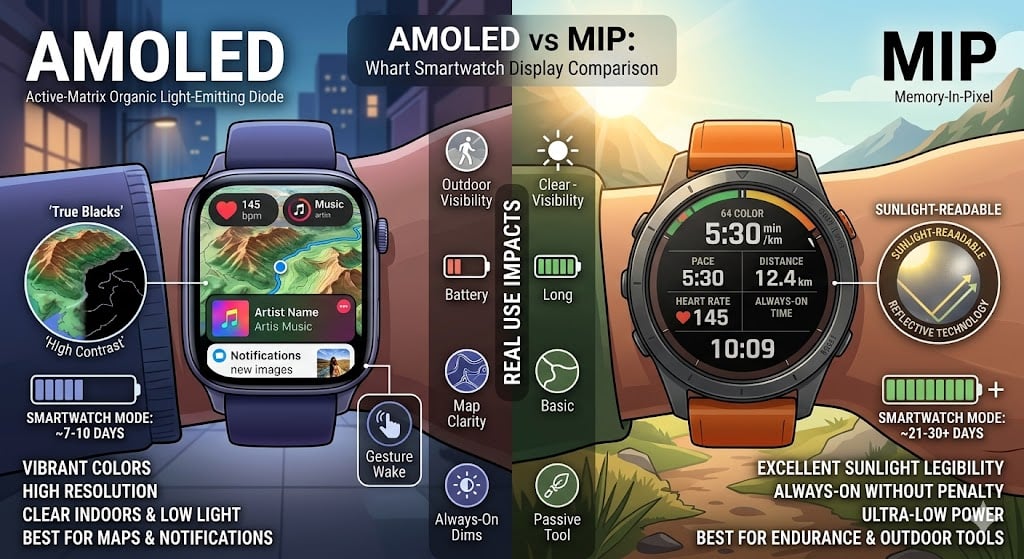
AMOLED vs MIP: What Smartwatch Displays Change in Real Use
Display technology shapes the way a smartwatch feels every day. Processor speed, sensors, and software features matter, but the screen is the part users interact with most. It determines readability, battery behavior, color, always-on performance, and even which watch faces look good.
In Garmin watches, two display types are often discussed: AMOLED and MIP. Both can be useful, but they serve different priorities. Understanding the tradeoffs helps users choose a watch and configure its screen more intelligently.
What AMOLED Does Well
AMOLED screens are bright, colorful, and high contrast. Black areas can look very deep, while icons, charts, and modern watch faces can appear crisp and vivid. This makes AMOLED attractive for users who want a more polished smartwatch experience.
AMOLED is especially strong for indoor readability, detailed graphics, and faces with rich color. It can make a watch feel closer to a modern phone or premium wearable. For users who care about visual style, that is a major advantage.
Where MIP Still Makes Sense
MIP, or memory-in-pixel, is less flashy. Colors are usually more muted and contrast can look lower indoors. But MIP can be very efficient and readable in daylight, especially on watches designed for outdoor use.
For long hikes, endurance sports, or users who dislike frequent charging, MIP still has a practical appeal. It may not look as dramatic in product photos, but it can be dependable in conditions where battery life and sunlight readability matter more than color depth.
Battery Life Is Not Just the Panel
Display type affects power use, but it is not the only factor. Brightness, always-on mode, gesture wake, GPS, sensors, notifications, music, maps, and the watch face itself can all influence battery life.
That is why two users with the same model may report different endurance. One may run a simple low-refresh face with conservative settings, while another uses a bright always-on face with many live data fields. The hardware is the same, but the experience is different.
Watch Faces Need to Match the Screen
A face designed for AMOLED may rely on deep blacks, gradients, and small colorful details. On MIP, that same design may look flat or busy. A face designed for MIP may be clear and efficient, but it may look too plain on a vivid AMOLED screen.
For Garmin users comparing AMOLED vs MIP Garmin displays, the watch face is part of the decision. The panel affects not only specs, but also which layouts feel readable and which designs make sense for daily use.
Always-On Behavior Changes the Experience
Always-on display is one of the biggest practical differences. AMOLED watches can offer attractive always-on modes, but they usually need careful dimming and simplified layouts to preserve battery. MIP watches are often naturally suited to persistent visibility.
Users should test how a face looks in its low-power state, not only in the bright preview. A great full-power design can become less useful if the always-on version hides the data the user cares about.
Choosing Between Them
AMOLED is often the better choice for users who want vivid visuals, modern interface polish, and strong indoor readability. MIP remains appealing for users who prioritize long battery life, outdoor use, and low-maintenance visibility.
Neither display type is universally better. The right choice depends on the environment, charging habits, visual preference, and how much information the user wants on the wrist. Once that choice is made, selecting a watch face that respects the panel is the next step.
The Screen Is a System
A smartwatch display is not just a rectangle of pixels. It is a system made of panel technology, brightness settings, software behavior, power management, and design. When all of those pieces work together, the watch feels clearer and more reliable.
That is the real lesson of AMOLED versus MIP. The best display is the one that matches how the watch will be used, then gets paired with a face that makes the strengths of that screen easy to see.