8 Essential Marketing Tools Every Store Should Use in 2026
Professional Marketing for Retail Stores:
Successful retail stores don’t rely on great products alone—they rely on smart retail marketing. From attracting new customers to increasing repeat purchases, modern marketing tools help stores grow faster while saving time and reducing costs.
Whether you own a clothing boutique, convenience store, electronics shop, furniture showroom, grocery store, or multi-location retail business, investing in the right marketing software for retail stores can dramatically improve customer engagement and increase sales.
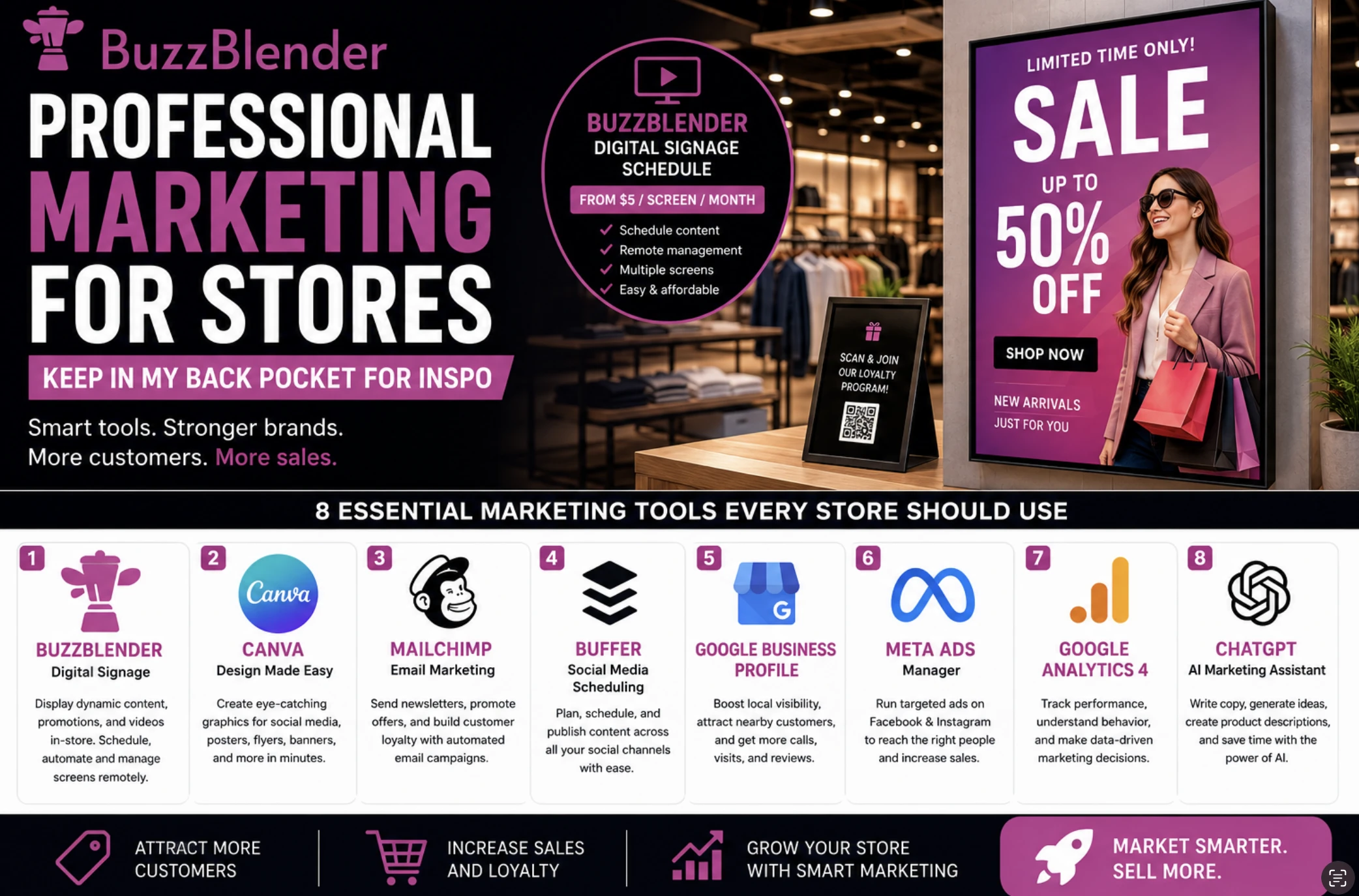
This guide covers eight affordable marketing tools that every store owner should keep in their back pocket.
1. BuzzBlender — Digital Signage Software for Retail Stores
One of the most effective forms of in-store marketing is digital signage.
Instead of printing posters every week, retailers can display dynamic content on digital screens that automatically updates throughout the day.
Use digital signage to promote:
- Flash sales
- New arrivals
- Seasonal collections
- Loyalty programs
- QR codes
- Cross-selling opportunities
- Holiday promotions
- Product videos
Unlike printed signs, digital displays can change automatically based on time, date, or location.
With BuzzBlender Digital and its signage schedule, retailers can schedule playlists, automate marketing campaigns, and remotely manage every screen from one cloud dashboard.
Why retailers choose BuzzBlender
- Digital signage from $5 per screen/month
- Setup in about 4 minutes
- Cloud-based management
- Unlimited content scheduling
- Multiple screen support
- Remote updates
- Easy playlist creation
- Perfect for single stores and retail chains
If you’re looking for affordable digital signage softwares for retail stores, BuzzBlender is one of the most cost-effective solutions available.
2. Canva — Create Professional Retail Marketing Designs
Every retail business needs attractive marketing materials.
With Canva, stores can create:
- Sale posters
- Window signs
- Product flyers
- Instagram posts
- Facebook ads
- Gift cards
- Promotional banners
- Email graphics
Thousands of retail-focused templates make it easy to produce professional marketing materials without hiring a graphic designer.
Best for: Small retail businesses looking for affordable graphic design software.
3. Mailchimp — Email Marketing for Retail Stores
Email marketing continues to deliver one of the highest returns on investment.
Mailchimp helps retailers:
- Send newsletters
- Announce promotions
- Recover abandoned carts
- Launch seasonal campaigns
- Build customer loyalty
- Segment audiences
Automated email marketing keeps customers returning long after their first purchase.
Best for: Customer retention and promotional campaigns.
4. Buffer — Social Media Marketing
Consistency is essential for retail marketing.
Buffer helps stores schedule content across:
- X (Twitter)
Instead of posting manually every day, retailers can prepare an entire month’s social media calendar in advance.
Features include:
- Content scheduling
- Analytics
- Team collaboration
- Automatic publishing
Best for: Social media management.
5. Google Business Profile — Local Store Marketing
One of the most powerful free marketing tools for retail stores is Google Business Profile.
A well-optimized profile helps your store appear in:
- Google Search
- Google Maps
- Local Shopping results
Customers can:
- View opening hours
- Read reviews
- Call your store
- Get directions
- Browse products
- See photos
Regular updates improve local SEO and help attract nearby shoppers.
Best for: Local retail marketing.
6. Meta Ads Manager — Facebook & Instagram Advertising
Social advertising remains one of the fastest ways to reach new customers.
Meta Ads Manager allows retailers to promote:
- New product launches
- Holiday campaigns
- Local offers
- Clearance sales
- Seasonal promotions
- Store events
Advanced audience targeting ensures your ads reach people who are most likely to buy. Meta campaigns can also form part of a broader strategy for paid ads for online stores, alongside Google Shopping and Search advertising.
Best for: Paid social media advertising.
7. Google Analytics 4 — Retail Marketing Analytics
Successful marketing depends on data.
Google Analytics helps retailers understand:
- Website traffic
- Customer behavior
- Best-performing products
- Conversion rates
- Campaign performance
- Sales funnels
These insights help businesses optimize marketing budgets and improve ROI.
Best for: Marketing performance measurement.
8. ChatGPT — AI Marketing Assistant
Artificial intelligence has become one of the most valuable marketing tools for retailers.
ChatGPT helps businesses create:
- Product descriptions
- SEO articles
- Social media captions
- Email newsletters
- Advertising copy
- Marketing ideas
- Landing pages
- FAQ content
Instead of spending hours writing content, retailers can generate high-quality marketing materials in minutes.
Best for: Content marketing and SEO.
Build a Complete Retail Marketing System
The best retail marketing strategies combine several technologies that work together.
For example:
- Create graphics in Canva.
- Generate copy with ChatGPT.
- Schedule emails using Mailchimp.
- Publish social posts through Buffer.
- Promote campaigns with Meta Ads.
- Measure results in Google Analytics.
- Display the same promotion in-store using BuzzBlender Digital Signage.
This creates a consistent customer experience across both online and physical stores.
Why Digital Signage Is One of the Best Investments for Retail Stores
Among all retail marketing technologies, cloud digital signage software often provides one of the fastest returns on investment.
Digital screens allow retailers to:
- Increase impulse purchases
- Promote high-margin products
- Eliminate printing costs
- Instantly update promotions
- Maintain consistent branding
- Improve the in-store shopping experience
Unlike static posters, digital signage keeps marketing fresh and relevant every day.
Using BuzzBlender Digital Signage Schedule, retailers can automate content, schedule campaigns by time or date, remotely control displays, and manage multiple store locations from a single dashboard. With pricing starting at just $5 per screen/month, it’s one of the most affordable digital signage solutions for retail businesses.
Final Thoughts
Professional retail store marketing doesn’t require an enterprise budget—it requires the right technology.
By combining digital signage software, email marketing, social media management, graphic design tools, analytics, AI content creation, and local SEO, retailers can attract more customers, improve brand visibility, and increase sales.
Whether you operate a single retail store or a nationwide chain, tools like BuzzBlender, Canva, Mailchimp, Buffer, Google Business Profile, Meta Ads Manager, Google Analytics, and ChatGPT provide an affordable foundation for modern retail marketing that delivers measurable business results.