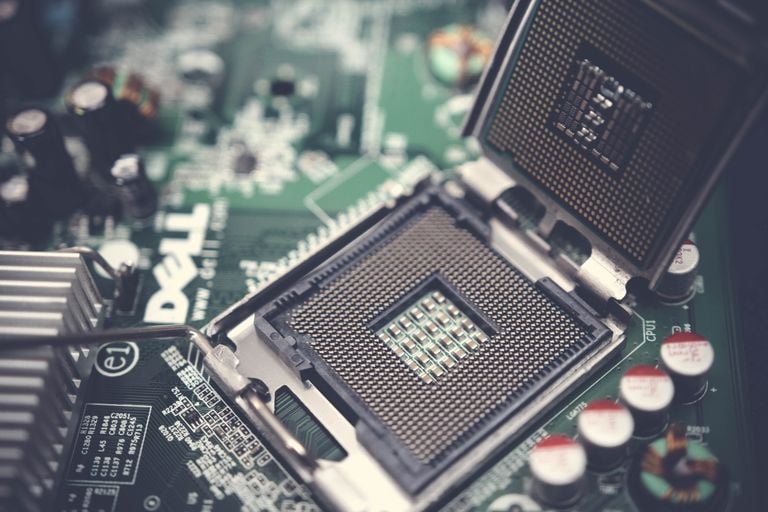
Automotive Electronic Chips: The Silicon Heart of Modern Vehicles
The car industry is in the midst of its most significant transformation in a century. The steady hum of electric vehicles (EVs) and the promise of self-driving cars, powered by sophisticated Advanced Driver-Assistance Systems (ADAS), are no longer science fiction. But what is the invisible force driving this revolution? The answer lies in the smallest of components: automotive electronic chips. These tiny silicon marvels are the unsung heroes, forming the digital backbone of every modern vehicle, and their role is only becoming more critical.
Semiconductors in Every System
If you were to peel back the layers of a new car, you wouldn’t just find an engine and a chassis. You’d find a complex, interconnected network of electronics. A typical modern car can contain anywhere from 1,000 to 3,000 semiconductor chips [1]. In an electric vehicle, that number can be even higher. These chips are not just for the infotainment screen; they are deeply integrated into every aspect of the vehicle’s operation.
•Safety and ADAS: Automotive chips process vast amounts of data from cameras, LiDAR, and radar sensors to enable critical safety features like automatic emergency braking, lane-keeping assist, and adaptive cruise control. They are the decision-making brains that perceive the world and react faster than any human can.
•Powertrain Management: In both traditional and electric vehicles, semiconductors are essential. They control engine performance and emissions in combustion cars, while in EVs, they manage the battery system, optimize power delivery to the motors, and control the charging process, directly impacting the vehicle’s range and efficiency.
•Body and Chassis: From controlling the deployment of airbags and managing the anti-lock braking system (ABS) to operating power windows and intelligent lighting, specialized chips ensure the vehicle is safe, comfortable, and responsive.
•Infotainment and Connectivity: The rich, responsive displays, seamless smartphone integration, and in-car Wi-Fi that drivers have come to expect are all powered by high-performance processors, similar to those found in computers and smartphones.
The Unique Demands on Automotive Chips
Not all chips are created equal. A semiconductor destined for a car faces a much harsher reality than one in a smartphone. Automotive-grade chips must be incredibly robust and reliable, designed to function flawlessly for years under extreme conditions. They must withstand severe temperature fluctuations, from the freezing cold of winter to the intense heat of an engine bay, as well as constant vibrations and potential moisture.
To ensure this level of durability, the industry relies on stringent quality standards. The most recognized of these is the AEC-Q100 qualification from the Automotive Electronics Council. When a component is AEC-Q100 qualified, it signifies that it has passed a battery of stress tests, guaranteeing the high level of reliability required for automotive applications.
Nexperia: A Driving Force in Automotive Semiconductors
Among the key players supplying these critical components is Nexperia, a global semiconductor powerhouse headquartered in the Netherlands. While not always a household name, Nexperia is a fundamental part of the automotive supply chain, producing a vast portfolio of essential semiconductors. The company is a leader in discrete components, logic, and MOSFETs, which are foundational building blocks for almost every electronic system in a car [2].
Nexperia’s strength lies in producing high-volume, high-quality, and efficient components that are vital for automotive applications. With a significant portion of its business dedicated to the automotive sector, the company has thousands of products qualified for automotive use. These aren’t necessarily the headline-grabbing central processors, but the essential chips that manage power, control switches, and enable communication between different systems—functions that are absolutely critical for a vehicle’s operation.
The Importance of Voltage Level Translation
A modern car’s electronic architecture is a complex ecosystem where dozens of modules and sensors must communicate seamlessly. However, these different components often operate at different voltage levels (e.g., 1.8V, 3.3V, 5.0V). This is where specialized chips known as voltage level translators become indispensable. They act as digital interpreters, allowing low-voltage processors to communicate with higher-voltage peripherals and vice-versa.
An excellent example of such a component is the Nexperia NXS0108BQ-Q100X. This 8-bit translating transceiver is designed specifically for the challenges of the automotive environment. It enables bidirectional communication between components at different voltage levels and features auto-direction sensing, simplifying the design process. Crucially, it is AEC-Q100 Grade 1 qualified, ensuring it can operate reliably in a wide temperature range (-40°C to +125°C) and is robust enough for the rigors of automotive use [3]. Components like this are the glue that holds the complex electronic network of a car together.
The Future is Silicon
The journey of the automotive industry is inextricably linked to the advancement of semiconductor technology. As we move towards fully autonomous vehicles and even more efficient EVs, the demand for more powerful, more specialized, and more reliable automotive chips will only continue to grow. We will see a shift towards centralized computing architectures, where a few powerful domain controllers manage multiple functions, requiring even more sophisticated semiconductors.
From safety systems that protect our lives to the powertrain that drives us forward, automotive electronic chips are the silent, powerful heart of the modern vehicle. Companies like Nexperia, with their focus on robust and efficient essential semiconductors, are providing the critical components needed to build the safer, smarter, and greener cars of tomorrow.