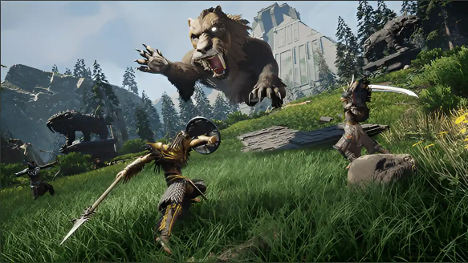
Arc Raiders: The Mathematics of Extraction and the $40 Gamble
The survival shooter genre is currently dominated by free-to-play games that rely on “battle passes” and cosmetic shops to generate revenue. Arc Raiders, made by Stockholm-based Embark Studios, has taken a calculated risk by moving away from that model. By changing to a premium $40 price point, the developers are indicating a shift toward a tighter, more substantial gameplay loop that is not diluted by the need to sell skins every five minutes. This is not just a shooter. It is a physics-based extraction simulation from the veterans of the Battlefield series.
Set in the visually gorgeous region of Calabretta, the game works on a ruthless PvPvE (Player vs. Player vs. Environment) logic. The main loop is not about how many enemies you kill, but rather how efficiently you spend your resources. Every raid is a mathematical equation in which you balance the cost of your ammunition with the possible value of the booty you may extract. Let’s dig deeper to ensure your high-level play.
The Grinding Reality of Speranza
The progression system is set around the “Speranza,” which is the underground colony that acts as your home. Upgrading this base requires certain resources that are only available on the surface. We are talking about rare circuits, polymer composites, and pristine energy cells. The drop rates for these are intentionally low in order to keep the economy scarce.
This is where the reality of the genre sinks in. To completely upgrade a character’s suite or unlock the best tier of weaponry, a player may have to complete dozens of successful extractions. The statistical probability of survival against twenty raids in a row without a squad wipe is low, especially when human opponents are added to the equation. This high-risk environment has created a clear market for external efficiency.
Skip the Grind: Buy Arc Raiders Items Effortlessly
Realizing the time investment needed to achieve end-game gear is massive, many players choose to buy Arc Raiders items through trusted third-party marketplaces like PlayerAuctions. By providing a secure platform for player-to-player trading, PlayerAuctions allows Raiders to bypass the punishing RNG of drop rates and acquire the specific components needed for base upgrades or weapon tiers. This lets them disown the statistical variance of “bad loot runs” and concentrate on high-level tactical play rather than endless grinding.
The Physics of Destruction: More Than Visuals
What makes Arc Raiders different from its competition is the implementation of granular destruction. The game makes use of proprietary tech that enables environment dismantling and makes a difference to gameplay. Cover is not permanent. A concrete wall can protect you from small arms fire. Here is how environmental destruction essentially alters the tactical approach to combat encounters.
- Verticality and debris — Destroying a catwalk is not just cool. It can cut off an enemy flank or crush a hostile squad beneath tons of steel.
- Line of sight manipulation — You can blow holes in structures to create new firing lanes, turning a defensive siege into an offensive ambush.
- Dynamic cover — Using the debris from a destroyed drone as makeshift shielding allows for mobile advances in open terrain.
This system requires players to think spatially. You cannot memorize the map as the map is liable to change as the firefight escalates.
The Economy of Time and “The Grind”
The progression system is set around the “Speranza,” which is the underground colony that acts as your home. Upgrading this base requires certain resources. These are only available on the surface. We are talking about rare circuits, polymer composites, and pristine energy cells. The drop rates for these are intentionally low in order to keep the economy scarce.
This is where the reality of the genre sinks in. To completely upgrade a character’s suite or unlock the best tier of weaponry, a player may have to complete dozens of successful extractions. The statistical probability of survival against twenty raids in a row without a squad wipe is low enough, especially when human opponents are added to the equation. This high-risk environment has presented the market for external efficiency.
Realizing the time investment needed to achieve end-game gear is massive, many players turn to Arc Raiders services in order to achieve a certain gear or guarantee an extraction. This lets them disown the statistical variance of “bad loot runs” and concentrate on the high-level tactical play.
The AI Behavior: The ARC Threat
The machines, known as ARC, do not work as normal video game enemies. They are run on a response-escalation system. At first, the surface may appear silent. However, the game keeps track of the noise level and visual profile of the squad. Engaging a small scout drone is not just a fight. It is a dinner bell.
Data from initial testing phases indicates that the ARC AI communicates across the map. If you fail to unscramble a “Watcher” unit within 5 to 10 seconds of detection, then the game spawns an escalation wave. This can vary from a squad of human-sized walkers to the giant “tyrants” in the trailers. The damage output of these high-tier units is calibrated to punish people who stand still. The “time-to-kill” (TTK) for a player caught in the open against a heavy unit of ARC is often less than two seconds.
Squad Composition and The Rule of Three
The game is optimized for three-player squads. This number is specific. It creates a triangle of responsibility that one player cannot cover all angles. With the loss of one player, the team’s capacity to fight is reduced by 33%. However, the tactical penalty is closer to 50% because one person would need to stop shooting to revive the fallen player.
In the current meta, often successful squads play a certain distribution of utility:
- The Scout — Equipped with long-range telemetry and sniper platforms to tag enemies and eliminate alarms before they trigger.
- The Breacher — Carries high-explosive ordnance to strip armor plating from heavy ARC units.
- The Support — Focuses on area denial and gadgets like the grapple hook or deployable cover to control the flow of the engagement.
This rigid adherence to roles means that solo play is mathematically discouraged. While possible, the amount of fire needed to take out high-level targets usually is more than the ammunition capacity of a single Raider.
Final Say!
Arc Raiders is shaping up to be a game about the arbitrage of resources. It asks a simple question. Is the loot in that vault worth the ammunition it will cost to open it? With the shift to a premium model, Embark Studios is wagering that players desire a deeper, punishing experience that respects their intelligence, even if not their survival rate.