ASUS Rampage III Extreme Motherboard
On-Board Peripherals
Contents
The south bridge chip used by Rampage III Extreme is Intel ICH10R, which supports six SATA-300 ports (RAID 0, 1, 5 and 10) and all these ports (black connectors) are placed on the motherboard edge rotated 90°, so video cards won’t block them, as you can see in Figure 4.
The red connectors are SATA-600 ports, controlled by a Marvell 88SE9128 chip, since the chipset does not natively support SATA-600 ports.
In Figure 4, you can see the SATA ports and a red button that switches which BIOS chip (there are two) is active. One LED near each chip shows which one is in use at the moment.
 Figure 4: SATA ports.
A JMicron JMB363 chip provides two additional SATA-300 ports, one near the SATA ports (mounted vertically on the board) and one as an eSATA-300 port on the motherboard rear panel.
No parallel ATA (PATA, a.k.a. IDE) port and no floppy disk drive controller are present.
This motherboard has nine USB 2.0 ports, seven soldered at the rear panel (one exclusive for "ROG Connect" feature, which allows you to control overclocking settings using another computer in real time) and two available through one header. This product also has two USB 3.0 ports on its rear panel (the blue ones) controlled by a NEC μPD720200 chip.
Two FireWire (IEEE1394) ports are provided, one standard-sized on the rear panel and one through a header on the motherboard. They are controlled by a VIA VT6315N chip. The motherboard comes with an I/O bracket containing two USB ports and one FireWire port.
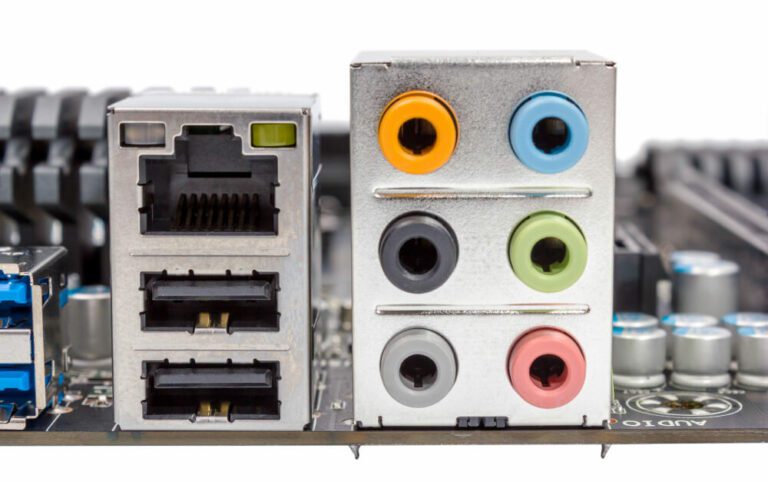
Audio is generated by the chipset using a Realtek ALC889 codec, which is a professional-grade component, allowing you to professionally work with this motherboard for audio editing and conversion (e.g., converting LPs and VHS tapes to digital format) without the need of an add-on audio card. The audio section provides 7.1 audio with 24-bit resolution, 108 dB signal-to-noise ratio for the outputs, 104 dB signal-to-noise ratio for the analog inputs and 192 kHz sampling rate for both inputs and outputs. This motherboard comes with an on-board optical SPDIF connect. Analog audio outputs use completely independent jacks, so you can hook-up an analog surround speaker system up to 7.1 without needing to “kill” the line in and/or mic in jacks. You can also add a coaxial SPDIF output by installing an adapter (not provided) on the SPDIF_OUT header available on the motherboard.
ASUS Rampage III Extreme has one Gigabit Ethernet port controlled by a Marvell 88E8059 chip, which is connected to the system using a PCI Express x1 lane and thus not presenting any potential performance issues. This particular controller incorporates features to off-load some tasks from the system CPU and
thus improve networking practical performance (for example, TCP/IP and UDP checksum calculation and check and TCP segmentation, and support for IEEE 802.1QAV standard for audio video bridging, AVB, for better quality of service on real-time audio and video transmissions). It is curious that this board comes with "only" one Gigabit Ethernet port, since most high end motherboard so far come with two Ethernet ports.