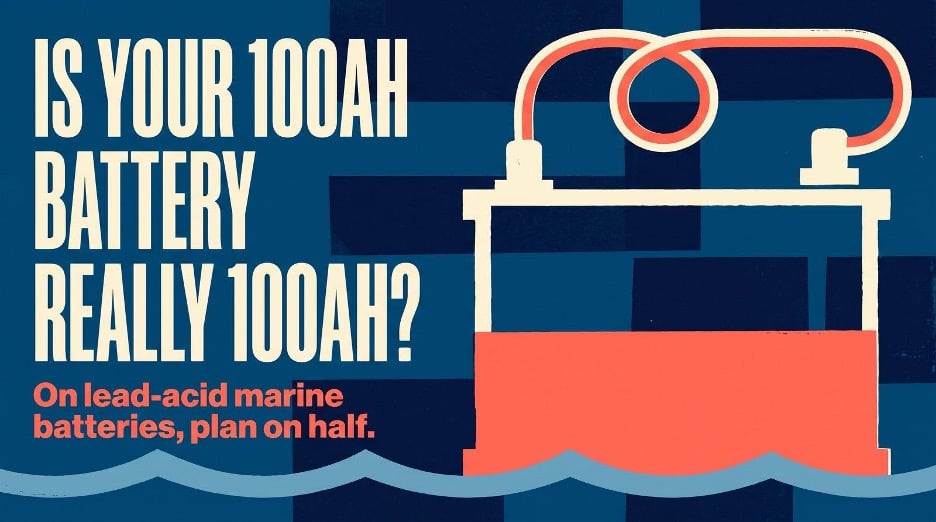
Best marine batteries for boating: lithium, AGM, and lead-acid compared
| TL;DR A 12V 100Ah lead-acid battery recharged at the usual 50% mark gives you about 600Wh. A 12V 100Ah LiFePO4 battery is rated for its full 1,280Wh.LiTime rates its lithium marine batteries at 4,000+ cycles at 100% depth of discharge and quotes AGM at 200 to 500 cycles. Both are the maker’s figures.Over its rated life, a hard-worked 12V 100Ah LiFePO4 battery comes to about 7 cents per kWh. Lead-acid would need to cost under about $21 to match (our estimate).Cold charging is lithium’s weak spot: LiTime’s 48V house battery stops accepting charge below 32°F. Short version: drain and recharge it often, and lithium is usually the cheaper battery over its life. If all it does is crank an engine, flooded or AGM still makes more sense. |
The crust on the left terminal is the kind of upkeep flooded lead-acid asks for. Sealed AGM cases cut most of it, and LiFePO4 needs no watering at all.
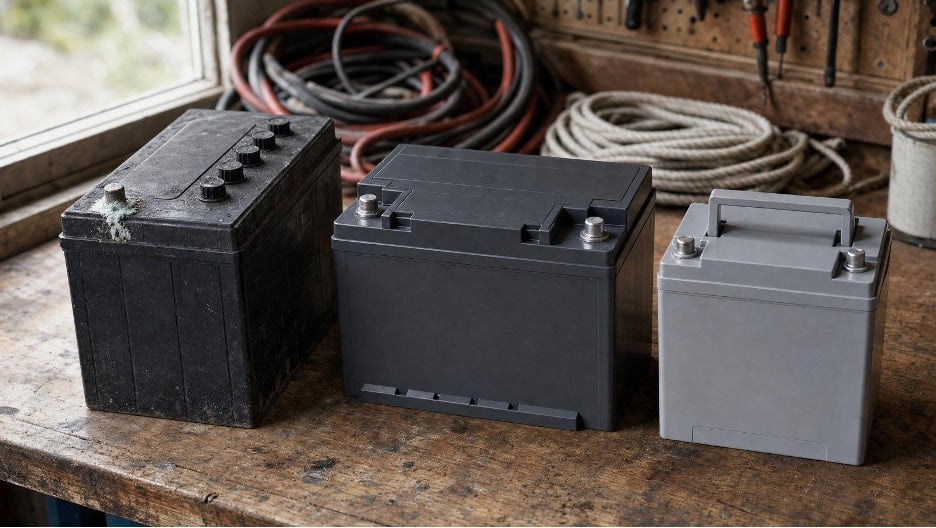
Spec sheets make two 12V 100Ah marine batteries look interchangeable. They aren’t. Treated for a long life, a flooded or AGM battery gives about half its label before it wants a recharge, while a LiFePO4 (lithium iron phosphate) battery is rated to run nearly flat, and from a higher nominal voltage. Same number on the case, close to double the usable energy.
That gap settles most of the comparison. For trolling motors and house loads, which drain the battery over and over, LiFePO4 is the stronger choice and usually costs less per kWh over its life. For a battery that only starts an engine, the lithium premium buys little, and a flooded or AGM cranking battery still makes sense. AGM is sealed but shares flooded’s usable capacity limit.
Why the same 100Ah rating delivers different energy
Usable energy is amp-hours times nominal voltage times the share of capacity you draw, and chemistry changes all three.
Start with voltage: a 12V-class LiFePO4 battery has four 3.2V cells, or 12.8V nominal, so 100Ah is 1,280Wh against 1,200Wh for six-cell lead-acid. Depth of discharge matters more. Common practice is to recharge lead-acid at about 50%, since repeated deep discharges shorten its life. LiTime rates its LiFePO4 marine batteries at 100% depth of discharge and suggests staying around 80% for best performance.
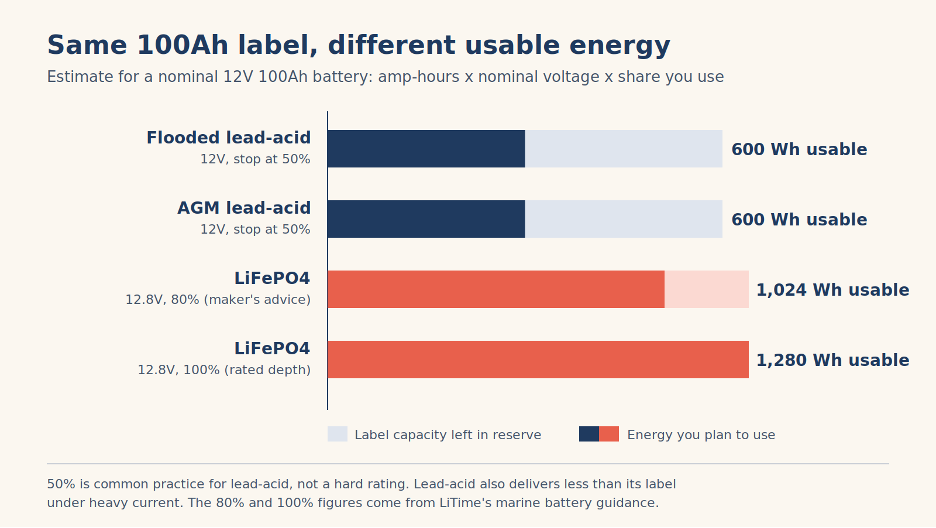
An estimate from nominal ratings. On a heavy trolling load a lead-acid battery falls short even of its 600Wh bar, because lead-acid amp-hour ratings are normally quoted at a slow discharge.
Flooded vs AGM vs LiFePO4, spec by spec
LiFePO4 leads on nearly every row that matters for a battery you cycle. Lead-acid wins on upfront price and on charging in a cold boat.
| Spec | Flooded | AGM | LiFePO4 |
| Usable capacity | About 50% | About 50% | 80 to 100% |
| Cycle life | Varies with depth of discharge | 200 to 500* | 4,000+ at 100% depth* |
| Service life | 2 to 5 years* | 2 to 5 years* | 10+ years* |
| Voltage under load | Sags steadily | Sags steadily | Nearly flat until empty |
| Charge acceptance | Slows over a long top-off | Slows over a long top-off | High current until nearly full |
| Cold | Weaker cranking; can freeze if flat | Weaker cranking; can freeze if flat | BMS blocks charging near freezing |
| Maintenance | Add water, clean terminals | Sealed, no watering | None |
| Weight, 12V 100Ah | Heavy | Heavy | 21 lbs for one LiTime model |
| Upfront price | Lowest | Middle | Highest |
*LiTime’s published figures, not independent tests.
Voltage under load is the row you feel on the water. Lead-acid voltage slides as the battery discharges, so a trolling motor slows through the day, while LiFePO4 holds near nominal until it is almost empty. The catch: a voltmeter says little about a lithium battery’s charge, so a Bluetooth monitor is worth having.
How long do marine batteries last? LiTime puts lead-acid at 2 to 5 years and its LiFePO4 at more than a decade. Storage decides where lead-acid lands: leave one discharged and it sulfates, which the Battery Council International glossary describes as lead sulfate crystals turning “to a state that resists recharge.”
Cold cuts both ways. Lead-acid loses cranking power but still charges. LiTime’s 48V house battery, by contrast, stops charging below 32°F and resumes at 41°F, which is why self-heating models exist.
Which chemistry wins each job
The load profile picks the chemistry.
Starting only
A cranking battery gives a few seconds of high current, then the engine’s charging system refills it. Cycle life hardly matters here. Meeting the engine maker’s CCA or MCA figure and fitting the tray does, and a flooded or AGM starting battery covers both for the least money.
Trolling motors and house loads
A trolling motor drains the battery deep every trip and slows as voltage sags. Fish finders, radios and lights sip current for hours. LiFePO4 handles both better than lead-acid. LiTime’s sizing guide pairs 12V with 30 to 70 lb thrust, 24V with 70 to 100 lb and 36V with 100 to 120 lb. If you’re shortlisting the best marine battery for a 12V trolling motor, its 12V 100Ah TM models run $355.99 to $375.99 at the time of writing.
Dual purpose
One battery has to crank and run accessories, and lead-acid dual purpose designs compromise between the two. A lithium version is worth a look only with a published cranking rating, such as the 1200 CCA and 1300 MCA listed for LiTime’s 12V 165Ah Dual Purpose Smart Self-Heating, a Group 31 battery at $589.99 at the time of writing.
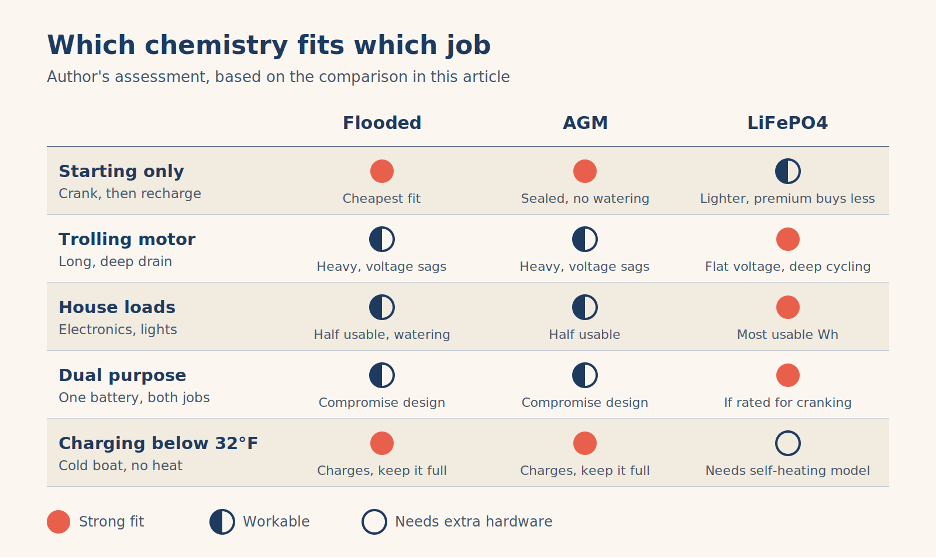
Author’s assessment. Cold charging is the only row where lithium needs extra hardware, and a self-heating battery fixes that rather than ruling the chemistry out.
Cost per kWh, not cost per battery
Divide what you pay by the energy the battery delivers before it wears out. On that basis LiFePO4 wins clearly for a battery you cycle hard, and the margin shrinks with light use.
| Estimate | LiFePO4: 12V 100Ah TM Smart at $355.99 | Break-even price for 12V 100Ah lead-acid |
| Cycled hard, cost per kWh | 1.28kWh x 4,000 cycles = 5,120kWh, about 7.0 cents per kWh | 0.6kWh x 200 to 500 cycles = 120 to 300kWh, so about $8 to $21 |
| Weekend use, cost per year | $355.99 over 10 years, about $36 a year | $36 x 2 to 5 years of life, so about $71 to $178 |
These estimates rest on the maker’s claims and ignore capacity fade, charger losses and lead-acid’s shortfall under heavy current. And 4,000 cycles in ten years is more than one a day, which few recreational boats come near, so for most owners the weekend row is the real one. Hold your own quote against the break-even column.
Disposal counts too. Lead-acid has a long established take-back route through battery retailers. Lithium doesn’t belong in household trash or curbside bins; the EPA’s guidance on used lithium-ion batteries says to take it to a recycling or household hazardous waste collection point with the terminals taped.
How to read a marine battery spec sheet
Four entries carry most of a label’s information, each from a defined test or a simple formula.
| Figure | What it measures | Use it to |
| CCA | Amps a new, fully charged battery delivers at 0°F for 30 seconds while holding 7.2V or more (12V battery, BCI definition) | Meet the figure in your engine manual |
| MCA | A similar cranking test at a warmer temperature, so it normally reads higher than CCA | Compare only with other MCA figures |
| Ah and Wh | Ah is current multiplied by hours; Wh is Ah multiplied by nominal voltage | Compare Wh across chemistries, Ah only within one |
| RC | Minutes a new, fully charged battery at 80°F sustains 25A before falling to 1.75V per cell (BCI definition) | Gauge accessory time if charging fails |
Group size is about fit. Battery Council International’s group size system sorts batteries by dimensions, performance, terminal position and chemistry, and batteries in one group must match to within about 0.08 in (2mm). Fitting the tray is not the same as suiting the boat, a distinction Hardware Secrets also drew for phones in its repair technician’s checklist for replacement phone screens and batteries. Before swapping lead-acid for lithium, confirm your charger and the engine’s charging system have a lithium setting.
Pick by the job, not the label
A chemistry name and an Ah figure describe what’s in the case, not whether it suits your boat. A starting battery needs a cranking rating and a tray it fits, and lead-acid still delivers that cheaply. A trolling motor or house bank lives on usable watt-hours and repeat cycles, which is where LiFePO4 pays for itself. If the boat spends winter somewhere cold, that single fact should decide between a standard lithium battery and a self-heating one.