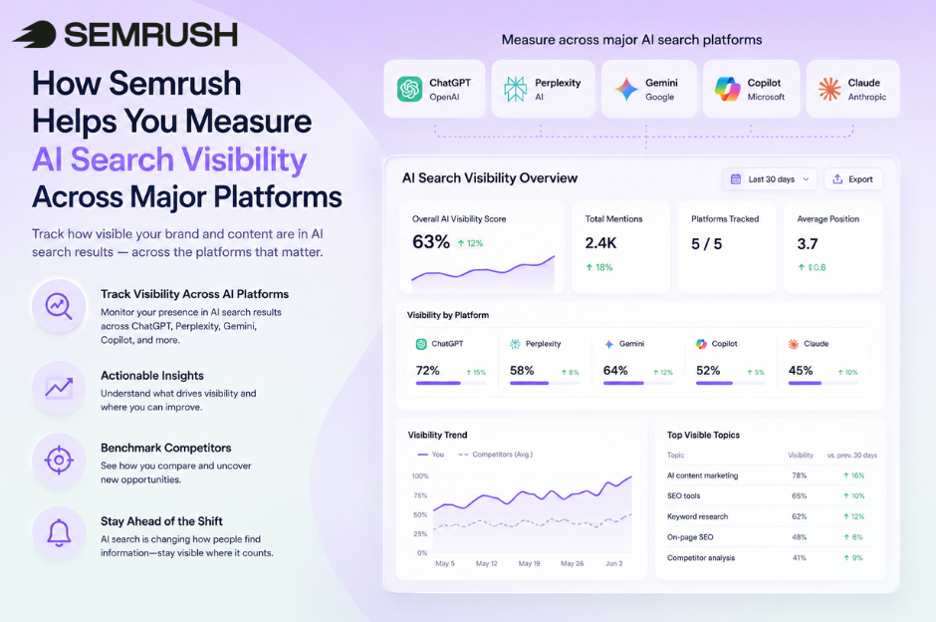
How Semrush Helps You Measure AI Search Visibility Across Major Platforms
**This post is sponsored by Semrush. When you purchase through links in this article, we may earn an affiliate commission from Semrush.**
For years, measuring SEO success was relatively straightforward. You tracked rankings, monitored organic traffic, and celebrated when more visitors found your website through Google.
That approach still matters, but it no longer tells the whole story.
Today, millions of people begin their research in ChatGPT, Google AI Overviews, Gemini, and Perplexity. Instead of clicking through a list of search results, they’re reading AI-generated answers that summarize information from multiple sources. If your brand isn’t included in those responses, you’re missing opportunities that traditional SEO reports may never reveal.
That’s why AI visibility deserves its own audit.
The good news is that you don’t need to guess whether AI platforms recognize your brand. With the right workflow and reliable data, you can identify where you stand today and create a plan for improving your visibility over time. Here’s how to do it.
Step 1: Measure Where You Stand Today
Before making changes to your content, establish a baseline.
Think of this as taking a snapshot of your current AI presence. Without it, you won’t know whether future improvements are actually working.
Semrush makes this process much easier through its AI Visibility Toolkit. Instead of relying only on keyword rankings, you can see how your brand appears across AI-powered search experiences, including Google AI Overviews, Google AI Mode, ChatGPT, Gemini, and Perplexity.
Pay attention to metrics such as your Visibility Score, Share of Voice, citation frequency, and competitor comparisons. Together, these paint a much clearer picture than rankings alone.
You may discover that your website performs well in traditional search but is rarely mentioned by AI assistants. Or you might find that competitors with lower rankings are cited more often because their content better answers common user questions.
The goal isn’t to judge your performance. It’s to understand your starting point.
Step 2: Find Out Why Competitors Are Being Cited
Once you’ve established your baseline, it’s time to look beyond your own website.
One of the quickest ways to uncover opportunities is by studying the brands that AI platforms already recommend.
Ask yourself a few questions.
Which competitors appear most often?
What topics are they being cited for?
Do they provide more complete answers, stronger examples, or clearer explanations?
Semrush’s competitor benchmarking and citation tracking features help answer these questions without hours of manual research.
Rather than copying another company’s content, look for gaps in your own. Maybe you’ve written about a topic but haven’t covered it in enough depth. Perhaps your article is outdated, or it answers a different question than the one users are asking today.
These insights often reveal opportunities you wouldn’t have noticed by looking only at keyword rankings.
Step 3: Strengthen Your Topical Authority
Many websites publish dozens of articles that loosely relate to the same subject but never build real authority.
AI search tends to reward content that demonstrates expertise across an entire topic instead of answering a single question in isolation.
Start by reviewing your existing content.
Are there important questions your audience still has?
Have industry trends changed since the article was published?
Would additional examples, data, or expert insights make the page more useful?
This is also a good time to identify missing keyword opportunities. Semrush can highlight related search terms, supporting topics, and content gaps that deserve attention.
Don’t focus on adding more words just to increase the length of the article. Focus on making it genuinely more helpful.
Often, a thoughtful update provides more value than publishing another article covering nearly the same subject.
Step 4: Improve the Structure Before You Publish
Great information can still be overlooked if it’s difficult to understand.
As you refresh your content, pay close attention to how it’s organized.
Clear headings, concise sections, descriptive titles, and logical internal links help readers navigate your content more easily. They also make it simpler for AI systems to identify the main ideas and determine which sections are worth citing.
Review technical SEO while you’re at it. Broken links, indexing issues, and slow-loading pages can limit your visibility even if the content itself is excellent.
If you’re just getting started with the platform, the Getting Started with Semrush: A Tutorial for Navigating the Essentials guide is a helpful resource for learning where to find these reports and how to use them within your workflow.
Step 5: Track Progress and Keep Improving
An AI visibility audit isn’t something you perform once and forget.
Search behavior continues to evolve, AI platforms update their models, and new competitors enter the market all the time.
After making meaningful improvements, monitor your Visibility Score, Share of Voice, citations, and competitor activity over the following weeks. Watch how these trends compare with your organic traffic and keyword rankings.
The goal isn’t to chase every small fluctuation. Instead, look for steady progress that shows your content is becoming more useful and more visible across both traditional search and AI-powered experiences.
This long-term perspective helps you make smarter decisions and avoid unnecessary changes based on short-term data.
The Future of SEO Includes AI Visibility
Traditional SEO isn’t disappearing. It’s expanding.
Businesses that continue focusing only on rankings will miss an increasingly important part of how people discover information online. At the same time, chasing AI visibility without building strong SEO fundamentals won’t produce lasting results either.
The most effective strategy combines both.
By regularly auditing your AI presence, identifying content gaps, strengthening topical authority, and monitoring progress with reliable data, you’ll be in a much better position to reach your audience wherever they choose to search.

If you’re ready to understand how your brand appears across today’s AI search platforms, explore Semrush and make AI visibility part of your regular SEO workflow. The sooner you establish your baseline, the sooner you can start making informed improvements that support both traditional search performance and the next generation of AI-powered discovery.