Why Gradient Patterns Have Become Icons of Prestige
Ever stop and think about how weird we are? As a species, I mean. We hustle our entire lives chasing stuff that has zero actual, real-world value. Shiny rocks we pull from the dirt, dried paint splotches on a canvas, little bits of paper with pictures of long-dead dudes on them. None of it means a thing. The only reason it does is because we all just kinda… agree it does. It’s this massive, shared delusion. A pact. And now, in the digital age, we’ve found something even more abstract to get worked up about: the simple color gradient.
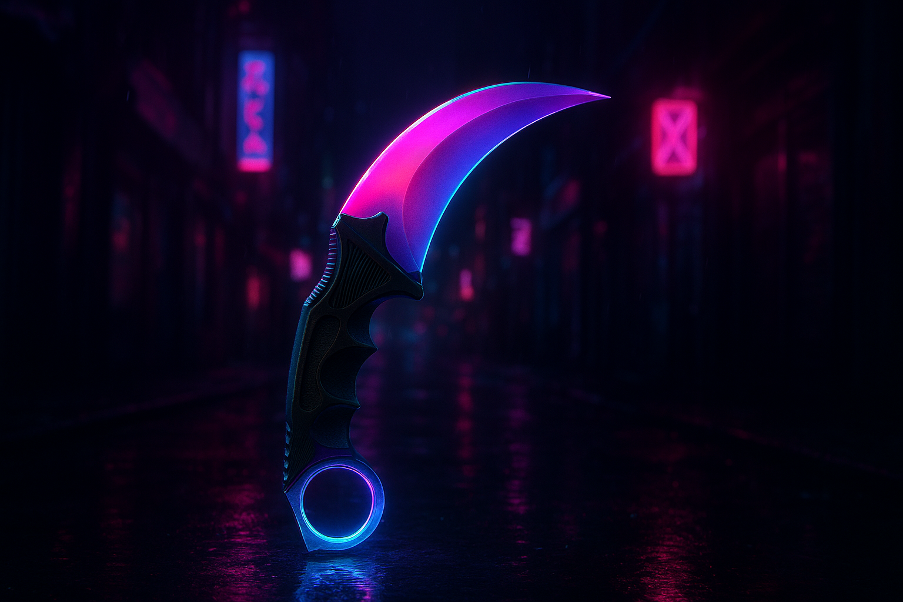
That’s it. Just a smooth shift from one color to another. Something you could cook up in an ancient version of PowerPoint. But in the right place, that blend of colors is worth more than a decent car. In the universe of CSGO and CS2, nothing says ‘I’m the king of this lobby’ quite like a Karambit Fade. It’s a wild phenomenon when you really think about it. How did we get to this point? How did a basic visual effect become this towering symbol of status in the world’s biggest tac-shooter? It’s not just a skin pattern; it’s a statement piece. It’s a whole saga about our weird brains, digital scarcity, and the strange art of the online flex.
The Primal Pull of ‘Oooh, Shiny’
Before we go full galaxy-brain on the digital side of things, we gotta start with the basics. Our brains are just wired to like pretty things, especially pretty things that are hard to get. For thousands of years, that meant stuff like gold, ’cause it never gets dull, or deep purple dye that took, like, a zillion sea snails to make one royal robe. We wanted them because they looked amazing and were incredibly scarce.
A gradient pattern tickles that same ancient lizard part of our brain. It looks like the most incredible stuff we see in nature. You know, like a killer sunset melting from bright orange into a deep purple, or the shimmery, rainbow sheen on a beetle’s back. These are beautiful, complex things you can’t just bottle up. And a really well-done gradient? It bottles that feeling. It’s a dynamic visual. It feels alive, not like some boring, flat color. In a game where you can’t physically touch anything, the visuals are everything. Color is the new texture. So a gradient isn’t just a color—it’s a whole landscape of them, painted on a tiny digital knife. It feels premium ’cause it copies something beautiful and rare from the real world.
From Corporate Blandness to Digital Bling
It’s pretty funny to look at the gradient’s glow-up in the design world. It was the absolute boss of the 80s and 90s, slapped on every corporate logo imaginable. Then, poof. It fell off a cliff. The 2010s were all about ‘flat design.’ Gradients were suddenly seen as super tacky and old-school. Everything had to be simple, minimalist, and aggressively flat.
But you can’t keep a good sunset down, man. Bit by bit, gradients wormed their way back into the cool kids’ club. Big tech led the charge. Remember the meltdown when Instagram swapped its old-school camera icon for that slick sunrise gradient? People freaked, but it was a sign of a huge shift. Gradients were back, but now they were clean, vibrant, and felt futuristic. They stood for innovation and energy. That cultural comeback was key. It retrained our brains to see gradients not as cheesy, but as genuinely cool and sophisticated. It was the perfect setup for the CSGO scene to grab the idea and turn it into a full-blown religion.
The CSGO Fade: How to Manufacture Desire
This is where it gets nuts. The magic of the “csgo fade” pattern isn’t just that it’s pretty. It’s the manufactured rarity that’s literally baked into its code. A Fade skin isn’t just a single thing. It’s defined by a percentage. This number tells you how much of that sweet, sweet gradient is actually visible on the weapon. An 80% fade might give you a lot of yellow and pink, but a 100% “full fade”? That gives you the whole glorious spectrum, all the way to that deep purple tip.
Right away, you have a pecking order. A 100% fade is just mathematically harder to get than a 95%, which is rarer than a 90%. But it goes even deeper. Every single skin in CSGO gets a unique “pattern index.” It’s a number that decides exactly how the texture map lands on the weapon model. This means there are hundreds of tiny variations of even a 99% fade. The community, being the glorious obsessives they are, has pinpointed specific patterns as being better than others, creating even more layers of rarity.
This whole system transforms a simple cosmetic into a high-stakes collector’s item, closer to a diamond than a digital paint job. The karambit fade price isn’t a single number; it’s a massive spectrum of prices based on these tiny, almost invisible details. When you decide to sell CSGO skins, that little shift in where the gradient starts and ends can be the difference of thousands of dollars. Folks looking to buy CSGO skins don’t just search for a “Fade”; they hunt for a specific percentage, a specific pattern. The marketplace for this stuff is a living thing, where tiny changes in a color pattern are argued over with the intensity of a Wall Street trading floor.
The Silent Language of the Lobby
So, what does this all mean when you’re actually in a match, trying to clutch a 1v3? Well, it means everything and nothing at all. A default knife works just as well as a flawless, 100% fade Karambit. But they are not the same. Not by a long shot.
That skin is a megaphone you don’t have to speak into. It tells everyone in the lobby something about you without you saying a word. Maybe you’re a long-time player, a shrewd trader, a ridiculously lucky case-opener, or just someone with cash to burn. Whatever it is, it screams dedication. It’s the same as rolling up to a car show in a limited-edition ride. People know what it is, and they know what it took to get it.
This whole vibe has only gotten stronger as we’ve all moved over to the CS2 skins market. The shiny new engine with its updated lighting makes these gradient skins pop like never before, cementing their top-dog status and cranking their value even higher. You see tons of CSGO skins for sale, but the Fades are still the kings. They’re the blue-chip stocks of the skin world. Having one is a badge of honor.
Is It All Just a Glorified Sunset Tax?
Alright, real talk. Are we all, as a community, a little bit nuts for losing our minds over a color swatch? Yeah. Probably. It is absolutely wild to see CSGO skin prices for a top-tier knife hit amounts that could be a down payment on a house. All for a bunch of pixels.
But it’s also a crazy look into what “value” even means anymore. The line between our physical and digital lives is getting blurrier every day. We spend so much time online that our digital stuff feels just as real, just as much a part of us as the clothes we wear. The flex is the same, just the venue has changed. We’re all just magpies at heart. We want the shiny thing.
Websites that serve as a market CSGO skins hub are the new art galleries. These platforms and market CSGO items are where this new kind of value gets decided. The community calls the shots on what’s cool, what’s rare, and what’s worth a fortune. And for a mix of reasons—part psychology, part design trends, part pure manufactured hype—we’ve all decided that the simple, clean gradient is one of the top icons of prestige.
In the end, it doesn’t matter if it’s the real sun dipping below the horizon or a pixelated one on the blade of your knife. We’re always going to be chasing that perfect fade. It’s a tale as old as time, just with a fancy new digital skin. And you know what? I’m here for it.