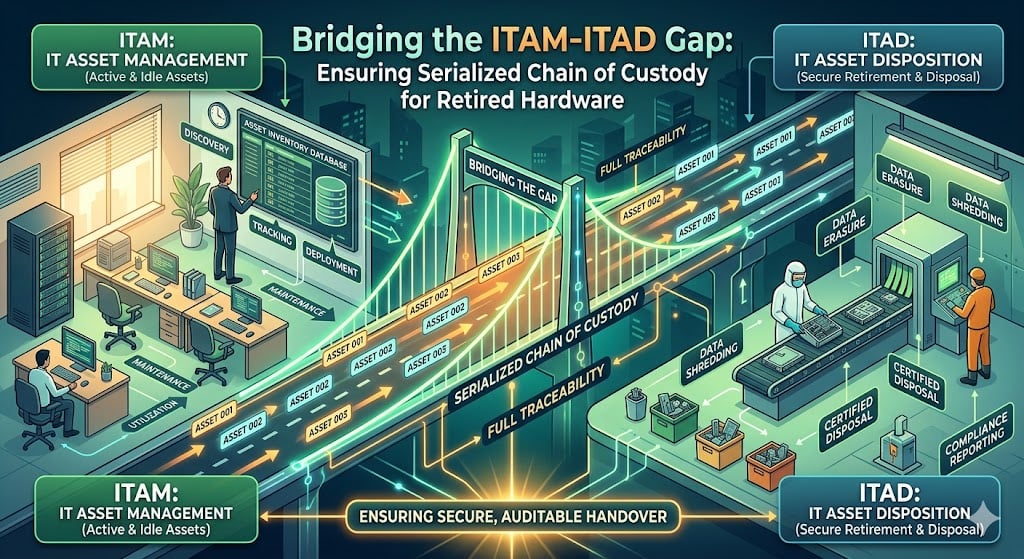
Bridging the ITAM-ITAD Gap: Ensuring Serialized Chain of Custody for Retired Hardware
When companies retire laptops, servers, or network equipment, there is a moment where the process gets dangerously informal. The asset management team has rows of serial numbers logged in a database. The logistics team has a dock full of hardware waiting for pickup. And somehow, between those two worlds, accountability often falls apart.
Bridging that gap is not just an operational issue. For regulated industries, it is a compliance requirement. For IT leaders who have survived a data breach or a botched disposal audit, it is personal.
Here is a look at how organizations can build tighter, more verifiable workflows between IT Asset Management (ITAM) tracking systems and the final disposition phase, and why the details matter more than most teams realize.
1. Understand Why the ITAM-ITAD Gap Exists in the First Place
Most organizations treat ITAM and ITAD as two separate functions. ITAM lifecycle management handles lifecycle tracking, software licensing, depreciation schedules, and inventory databases. ITAD handles what happens when devices reach end of life, whether that means resale, recycling, or certified data destruction.
The problem is the handoff. ITAM databases are built around procurement and active use. They are not always designed to follow an asset through decommission, staging, physical pickup, and downstream processing. When a device exits the building, the ITAM record often stops updating in real time.
That gap is where audits fail. It is also where liability lives.
2. Start With Serialized Logging at the Point of Physical Pickup
The most important change most organizations can make is deceptively simple: require serialized logging at the moment assets physically leave the facility.
This means the disposition vendor should be capturing serial numbers and model information at pickup, not back at their processing facility two days later. The difference matters for a few reasons:
- Chain of custody begins the moment a device leaves your control, not when it arrives somewhere else
- Serialized data captured at pickup can be cross-referenced against your ITAM lifecycle management in real time
- Discrepancies, missing assets, or substitutions get flagged immediately rather than weeks after the fact
For organizations managing thousands of endpoints, this is the difference between a defensible audit trail and a spreadsheet that stops making sense around row 400.
3. Map Your ITAM Fields to What Your ITAD Provider Actually Captures
Here is where many organizations run into friction. ITAM systems, whether they are ServiceNow, Lansweeper, or a custom-built database, contain rich asset data. But ITAD providers often work from their own intake forms, manifests, and internal tracking systems.
If those two data models do not align, reconciliation becomes a manual, error-prone process.
Before any large-scale refresh or decommission project, IT teams should sit down with their disposition provider and compare field structures side by side. Key questions to answer:
- Does the provider capture manufacturer serial numbers, asset tags, or both?
- How are asset conditions logged, and do those condition codes map to your internal depreciation records?
- Is the intake data exportable in a format your ITAM system can ingest?
- What is the turnaround time for receiving serialized confirmation after pickup?
Getting this alignment done upfront eliminates the back-and-forth reconciliation that tends to delay certificate issuance and close-out reporting.
4. Establish Clear Triggers for When an Asset Moves From ITAM to ITAD Status
One of the root causes of tracking breakdowns is ambiguous status categories. In many ITAM systems, an asset might sit in a “retired,” “pending disposal,” or “off-network” state for months before it is physically handed off.
The longer an asset lingers in limbo status, the harder it is to reconstruct what happened to it. IT teams should define clear, time-bound triggers that prompt formal handoff to an ITAD workflow, including:
- A defined number of days post-decommission before an asset must be staged for pickup
- A required status update in the ITAM system when an asset is physically removed from inventory
- A mandatory cross-check between ITAM records and the physical asset count before any pickup is confirmed
These triggers do not require new software. They require policy and consistency. But in organizations with large distributed estates, documented triggers are the only way to prevent assets from simply disappearing into administrative gray zones.
5. Require Audit-Ready Documentation From Your ITAD Provider
A Certificate of Data Destruction is a baseline. For organizations subject to HIPAA, GLBA, SOX, or state-level data privacy regulations, baseline is often not enough.
Audit-ready ITAD documentation should include serial-level reporting for every device processed, not just batch totals. It should include the method of data sanitization applied, whether that is NIST 800-88-compliant wiping, degaussing, or physical shredding, along with the date and technician attestation.
For organizations that resell or remarket retired hardware, downstream chain of custody matters too. Where did refurbished devices go? Were they sold domestically or exported? These questions come up in compliance reviews and e-waste audits, and organizations that cannot answer them face reputational and regulatory risk.
Choosing a provider that offers R2v3 certification and documented downstream accountability is not just due diligence. It is infrastructure for the compliance conversations that are coming.
6. Close the Loop: Feed Disposition Data Back Into Your ITAM System
Once hardware has been processed, the ITAM record should reflect that outcome. This is the step organizations most frequently skip, and it creates compounding problems.
When disposition data is not written back to the ITAM system, records become stale. Software licenses tied to retired hardware remain active. Depreciation schedules carry ghosts. And when it comes time for a software audit or an insurance claim, the gap between what the database shows and what actually exists becomes a real liability.
The fix requires coordination between your IT team, finance or procurement, and your ITAD provider. Specifically:
- Establish a format for disposition confirmation data, ideally a structured report with serial numbers, processing dates, and outcome codes
- Define who is responsible for updating ITAM records within a set window after receipt of that report
- Schedule a quarterly reconciliation review to catch any records that were not properly closed
This last loop, feeding verified disposition data back into the ITAM system, is what transforms a good process into an auditable one.
Closing Thought
The organizations that handle hardware retirement well are not necessarily the ones with the most sophisticated tools. They are the ones that treat the ITAM-to-ITAD handoff as a real compliance event rather than a logistics afterthought. Serial-level tracking, aligned data models, and documented chain of custody are not complex to implement. But they require intention, and a disposition partner who takes the same approach to accountability that your internal team does.