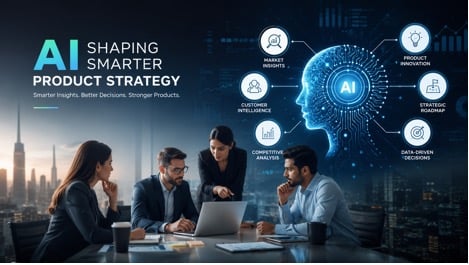
How AI is Changing Product Strategy Consulting in 2026
Product strategy used to move at the speed of quarterly planning cycles. A consultant would run discovery interviews, build a roadmap deck, present it to leadership, and revisit it three months later. That pace doesn’t hold anymore. In 2026, product strategy consulting looks less like a scheduled review and more like a continuous, data-fed decision process, and AI is the reason why.
This shift isn’t about replacing strategists with algorithms. It’s about changing what a strategist spends their time on. The work that used to eat weeks, like synthesizing thousands of customer reviews or mapping a competitor’s feature velocity, now takes hours. What’s left for the human consultant is judgment, prioritization, and the hard conversations about tradeoffs that no model can have on a company’s behalf.
This article breaks down exactly how AI is reshaping product strategy consulting, where it genuinely helps, where it falls short, and what businesses should watch for before betting their roadmap on a dashboard full of predictions.
Why Product Strategy Consulting Is Changing Faster Than Ever
Three forces are converging at once, and that’s rarely happened in this industry before.
First, the tools got good enough to trust for early-stage analysis. Large language models can now parse unstructured feedback, support tickets, app store reviews, and sales call transcripts at a scale no research team could match manually. As more organizations adopt AI across product planning, many also invest in AI Strategy Consulting to align these insights with long-term business objectives. Second, customer expectations shifted. Users expect products to adapt to their behavior within weeks, not release cycles. Third, competitive pressure compressed timelines. A startup can now prototype, test, and iterate on a product concept in the time it used to take just to finish the discovery phase.
Put those three together and you get consultants who are expected to deliver sharper recommendations, faster, with less room for the guesswork that used to be acceptable. Clients aren’t asking “what should our roadmap look like in six months.” They’re asking “what should we build this sprint, and how do we know it’s the right bet?”
That’s a fundamentally different job.
Traditional Product Strategy vs AI-Driven Product Strategy
It helps to see the contrast directly.
| Dimension | Traditional Approach | AI-Driven Approach |
| Market research | Manual reports, quarterly refreshes | Continuous monitoring, near real-time signals |
| Customer insight | Surveys, limited interview samples | Large-scale sentiment and behavior analysis |
| Competitive tracking | Periodic audits | Automated feature and pricing change alerts |
| Prioritization | Gut feel plus basic scoring models | Weighted models informed by usage data and predictive scoring |
| Roadmap updates | Quarterly | Rolling, adjusted as signals shift |
| Experimentation | Slow, resource-heavy A/B tests | Faster iteration cycles, AI-assisted variant generation |
| Consultant’s role | Researcher and analyst | Interpreter, challenger, and decision architect |
Notice the last row. That’s the real story here. The consultant’s job hasn’t shrunk, it’s moved up the value chain. Less time spent gathering data, more time spent deciding what the data actually means for the business.
The Biggest Ways AI Is Transforming Product Strategy Consulting
A few shifts stand out above the rest.
Speed to insight is the obvious one. What used to require a research sprint now happens in a working session. A consultant can pull customer sentiment trends, competitor movement, and usage patterns into a single conversation instead of three separate deliverables spread across weeks.
Pattern detection at scale matters just as much, maybe more. Humans are good at spotting patterns in small datasets and terrible at spotting them across tens of thousands of data points. AI closes that gap. It’ll catch a churn signal buried in support tickets that a research team would likely miss entirely.
Then there’s the shift from static to living roadmaps. Roadmaps built once a quarter and defended in a slide deck are becoming rare. Instead, teams treat the roadmap as a working document that responds to new evidence, adjusted through structured review points rather than a full re-plan every time something changes.
None of this eliminates the need for strategic judgment. It just means judgment gets applied to better inputs, more often.
How AI Improves Product Discovery
Discovery is where AI has made the most visible dent in consulting timelines.
Instead of manually coding hundreds of interview transcripts, a consultant can run them through a language model trained to flag recurring themes, emotional tone, and unmet needs. That doesn’t replace the interview itself. Talking to real users still surfaces context and nuance no model captures on its own. But the synthesis step, historically one of the slowest parts of discovery, now moves in a fraction of the time.
There’s a practical caveat worth stating plainly: AI-assisted synthesis is only as good as the raw input. Feed it shallow, leading interview questions and you’ll get shallow, misleading themes back. Good discovery still starts with good questions, asked by someone who knows how to listen for what isn’t being said.
AI for Market Research and Competitive Intelligence
Competitive intelligence used to mean someone on the team manually checking competitor websites, release notes, and review platforms every few weeks. That’s mostly automated now.
Tools can track pricing page changes, new feature announcements, hiring patterns that hint at product direction, and shifts in customer sentiment toward competitors, all continuously. A consultant walks into a strategy session already knowing that a competitor quietly dropped a tier, or that negative reviews are spiking around a specific feature.
This changes the nature of competitive strategy conversations. They’re less about “what do we think competitors are doing” and more about “here’s what’s actually happening, what do we do about it.” That’s a more useful conversation, and it happens faster.
AI-Powered Customer Research
Customer research has probably benefited the most from AI adoption, for one simple reason: volume. A human researcher can realistically review a hundred pieces of qualitative feedback in depth. AI can review ten thousand and still catch the same nuance in aggregate.
Sentiment analysis, topic clustering, and behavioral segmentation now happen automatically across reviews, support tickets, NPS comments, and session recordings. A consultant can identify that a specific user segment is silently struggling with onboarding, weeks before churn numbers would have made it obvious.
The caution here: statistical confidence in a pattern isn’t the same as understanding why it exists. AI will tell you that a segment is dissatisfied. It won’t reliably tell you the underlying emotional or contextual reason unless the data explicitly contains it. That’s still a human interpretation task, and skipping it is one of the most common mistakes businesses make.
AI in Product Roadmapping
Roadmapping tools now incorporate predictive scoring, usage data, and even sentiment signals to suggest what should move up or down in priority. Some platforms will auto-generate a draft roadmap based on a blended score of business value, technical effort, and customer demand.
That’s genuinely useful as a starting point. It’s a bad idea as a final answer.
A roadmap built purely on scoring models tends to favor features that are easy to measure over features that are strategically important but harder to quantify, like brand differentiation or long-term platform investments. A strong consultant uses the AI-generated draft as a provocation, something to argue with, not something to accept at face value.
Predictive Analytics in Product Strategy
Predictive models can now estimate the likely impact of a feature before it ships, based on historical patterns from similar releases. They can forecast churn risk, estimate adoption curves, and flag which customer segments are most likely to respond to a given change.
This is where product strategy starts to feel less like planning and more like risk management. Instead of asking “will this work,” teams ask “what’s the probability this works, and what’s our exposure if it doesn’t.” That’s a more mature way to make product bets, and it’s one of the clearest improvements AI has brought to the discipline.
The limitation is straightforward. Predictive models are trained on past behavior. They’re weaker at anticipating genuinely novel shifts, like a new regulatory requirement or a sudden change in user behavior triggered by an external event. Consultants who lean entirely on predictive output without stress-testing it against real-world context tend to get blindsided by exactly the kind of change the model couldn’t have seen coming.
AI and Product Prioritization
Prioritization frameworks like RICE, ICE, and weighted scoring models have existed for years. What’s changed is how the inputs get populated. Reach, impact, and confidence scores used to rely heavily on estimation. Now they can be grounded in actual usage data, cohort analysis, and predictive modeling.
A practical framework worth using in 2026:
Step one. Pull AI-generated usage and sentiment data for every candidate feature.
Step two. Score each feature using a standard framework, but flag any score built primarily on AI-predicted confidence rather than observed data.
Step three. Run a human review session specifically on the flagged items. These are the highest-risk, highest-uncertainty bets, and they deserve the most scrutiny, not the least.
Step four. Finalize priorities with both the data and the judgment call documented, so the reasoning survives when someone questions it later.
That last step matters more than people expect. Six months from now, someone will ask why a feature got deprioritized. “The model said so” is not an answer that holds up in a board meeting.
AI for Pricing Strategy
Pricing has quietly become one of the stronger use cases for AI in product strategy work. Willingness-to-pay analysis, competitor price tracking, and elasticity modeling used to require specialized pricing consultants and months of data collection. Now a lot of that groundwork happens continuously in the background.
That said, pricing is one of the areas where over-trusting the model does real damage. Price changes affect existing customers, not just new ones, and AI models trained mostly on acquisition data can miss the retention and trust cost of a pricing move. A consultant’s job here is to weigh the model’s recommendation against the parts of the business it can’t see, like brand positioning and customer relationships built over years.
AI in Go-to-Market Planning
Go-to-market planning has become noticeably more targeted. AI tools can segment audiences with far more precision, model messaging performance before launch, and identify which channels are likely to perform best for a specific product and audience combination.
What used to be an educated guess about launch sequencing is now closer to a modeled decision. Teams can simulate different launch scenarios and estimate outcomes before committing a budget. That reduces waste, especially for companies operating with limited marketing spend.
Consultants advising on go-to-market strategy increasingly pair this modeling with a firm’s own AI strategy work, since go-to-market decisions and broader digital transformation priorities tend to be more connected than most teams initially assume. Businesses working through this shift often bring in dedicated AI strategy consulting support specifically to make sure GTM decisions align with the company’s wider technology roadmap rather than existing in isolation.
AI-Powered Product Experimentation
Experimentation cycles have compressed dramatically. AI can generate test variants, predict likely outcomes before a test even runs, and analyze results with statistical rigor that used to require a dedicated data analyst.
Many organizations start by validating AI-driven ideas through an MVP development approach before expanding successful experiments into full-scale product initiatives. Volume isn’t the same as insight. A consultant’s value here is knowing which tests actually matter to the strategic question at hand, and resisting the urge to test everything just because testing got cheap.
Risks of Over-Reliance on AI
A few patterns show up repeatedly with businesses that lean too hard on AI-driven recommendations.
Teams start optimizing for what’s measurable instead of what’s meaningful. Metrics that AI can track easily start driving decisions, while harder-to-quantify factors like brand trust or long-term platform health get quietly deprioritized.
Strategic diversity shrinks. When multiple companies in the same space use similar AI tools trained on similar data, their strategic recommendations start converging. That’s a real competitive risk. Differentiated strategy increasingly comes from how a company interprets and acts on shared data, not from the data itself.
Accountability gets fuzzy. “The model recommended it” becomes a way to avoid ownership of a bad call. That’s a leadership problem as much as a technical one, and it needs to be addressed directly with the team, not left to resolve itself.
Where Human Product Strategists Still Create the Most Value
This is the part clients most want to understand, and it’s worth being direct about it.
Humans are still better at reading organizational context. A model doesn’t know that the engineering team is burned out, that a key stakeholder has a personal stake in a specific feature, or that the company’s culture makes certain changes politically harder than the data alone would suggest. Strategy lives inside that context, not outside it.
Humans are still better at making tradeoffs under genuine ambiguity. AI is strong when there’s enough historical data to model a pattern. It’s much weaker when a company is doing something genuinely new, entering a market with no clean historical comparison, or making a values-based decision where the “right” answer isn’t a number.
And humans are still the ones who have to stand in front of a leadership team and defend a recommendation, absorb pushback, and adjust the plan in real time based on questions nobody anticipated. That’s not a data problem. That’s a relationship and communication skill, and it remains firmly human territory.
Practical AI Tools Product Consultants Are Using
Consultants working in this space in 2026 typically rely on a mix of tools rather than a single platform:
- Large language models for qualitative synthesis, transcript analysis, and drafting research summaries
- Product analytics platforms with built-in predictive scoring for usage and churn signals
- Competitive intelligence trackers for pricing, feature, and sentiment monitoring
- Roadmapping tools with AI-assisted prioritization suggestions
- Experimentation platforms that support faster variant testing and automated statistical analysis
None of these tools work well in isolation. The value comes from a consultant who knows how to pull signals from each one and reconcile them into a coherent recommendation, not from any single platform’s output on its own.
Real Business Examples and Mini Case Studies
A mid-size SaaS company noticed a spike in support tickets around a specific workflow. Manual review would have taken a research team days to categorize and quantify. AI-assisted analysis flagged the pattern within hours, tying it to a specific user segment that had recently onboarded through a new integration. The fix shipped within a sprint instead of waiting for the next planning cycle.
A consumer app team used predictive modeling to forecast the likely adoption curve for two competing feature concepts before building either. The model favored one option strongly. The consultant on the project pushed back, pointing out that the favored option conflicted with the brand’s stated privacy positioning. Leadership chose the second option instead. Adoption came in slower, but retention and customer sentiment held up far better over the following two quarters, which mattered more to the business long term.
A B2B platform used AI-driven competitive tracking to catch a pricing change from a major competitor within days rather than the usual month-plus lag. That gave the team time to adjust messaging before the shift affected their own renewal conversations.
None of these stories are about AI making the decision. They’re about AI surfacing the information faster, and a human deciding what to do with it.
Common Mistakes Businesses Make When Using AI
A few mistakes show up again and again.
Treating AI output as a finished recommendation instead of a starting point. Skipping the human review step because the data “looks solid.” Using tools trained on generic datasets for decisions that depend heavily on company-specific context. Letting AI-driven metrics quietly replace strategic goals instead of supporting them. And running too many experiments at once, generating more data than the team can realistically interpret and act on.
Most of these come down to the same root issue: mistaking speed for certainty. AI makes analysis faster. It doesn’t make a decision correctly.
Best Practices for Combining AI with Human Expertise
A workable approach looks something like this. Use AI for the heavy lifting: data synthesis, pattern detection, and initial scoring. Use human judgment for the interpretation, the tradeoffs, and anything touching brand, trust, or organizational politics. Document the reasoning behind every major call, not just the recommendation itself, so decisions can be revisited intelligently later. And build in a deliberate pause between “the model suggests this” and “we’re committing to this,” even if that pause is just a thirty-minute review session.
Companies exploring how to build this kind of workflow often start with a smaller, contained initiative rather than overhauling their entire product process at once. Running a focused MVP development effort is often a practical way to test an AI-informed strategy on a limited scope before applying the same approach across a full product line.
Future of Product Strategy Consulting
The next few years will likely bring tighter integration between AI tools and the actual planning process, less separation between “the research phase” and “the decision phase.” Consultants will spend less time producing reports and more time facilitating decisions in real time, with data pulled live into the conversation.
The consultants who struggle will be the ones who position themselves as data gatherers, since that part of the job is disappearing fast. Businesses looking to build this capability often partner with experienced Product Strategy Consulting teams that combine strategic decision-making with practical AI implementation expertise.
Businesses evaluating outside support for this kind of work increasingly look for firms that combine strong product strategy consulting practices with genuine technical fluency in AI tooling, rather than treating the two as separate specialties.
Final Takeaways
AI has made product strategy faster, more evidence-based, and more scalable. It hasn’t made it easier to get right. If anything, the bar for good judgment has gone up, because the volume of information available now makes it easier than ever to justify a weak decision with a confident-looking chart.
The businesses getting the most value from AI in product strategy aren’t the ones using the most tools. They’re the ones who’ve figured out exactly where to trust the model and exactly where to override it.
Conclusion
AI has genuinely changed what product strategy consulting looks like day to day. Discovery moves faster. Competitive intelligence updates in near real time. Roadmaps respond to evidence instead of waiting for the next quarterly review. None of that is exaggeration, it’s simply how the work gets done now.
What hasn’t changed is the core of what makes a strategy good: judgment under uncertainty, the ability to weigh factors a model can’t see, and the willingness to make a hard call and stand behind it. Businesses that treat AI as a tool for better thinking, rather than a replacement for it, are the ones building product strategies that hold up under pressure. The strongest path forward isn’t choosing between AI and human expertise. It’s knowing exactly how to combine the two.