Layered Security: Combining Detection Technologies
Facility security is no longer limited to one single piece of equipment at the entrance door. There are many kinds of threats including weapons, restricted items, concealed items, health threats and so forth; and none of the detection equipment can detect them all. This is the reason why multi-layered security, where several pieces of security equipment are used at various stages of the visiting process, is now considered the standard practice in schools, courts, corporate headquarters, and event centers.
What Layered Security Actually Means
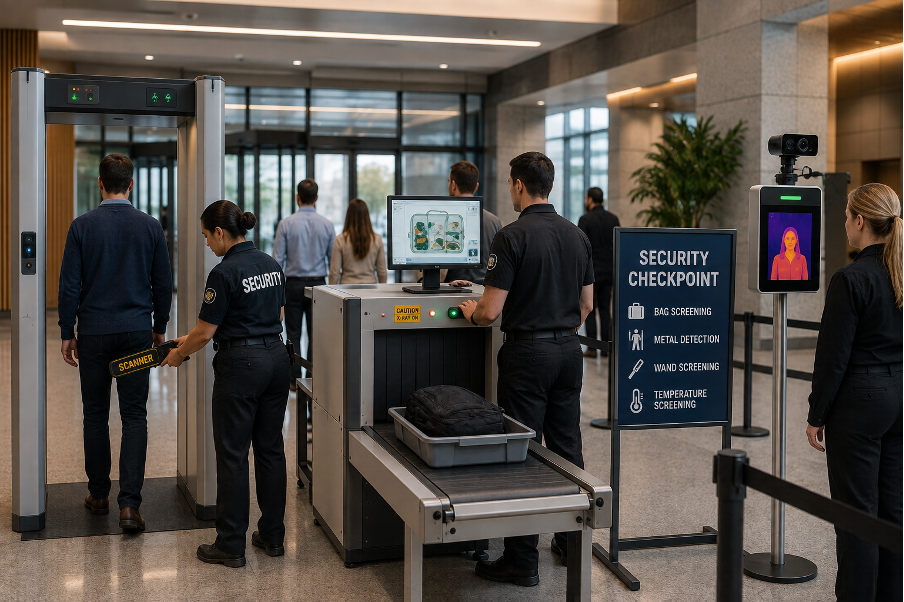
Layered security isn’t about stacking redundant equipment – it’s about assigning the right detection method to the right risk. A typical layered checkpoint might combine:
- Metal detector walk-through systems for initial screening of everyone coming in
- X-rays for bags and backpacks and packages that cannot be visually screened
- Wands for follow-up screening if the metal detector rings
- Body scanners for monitoring body temperature where there is a public health risk also
Each layer covers a gap the others leave open. A metal detector won’t see inside a backpack. An X-ray scanner won’t screen the person carrying it. Used together, they cover both the person and their belongings.
Why One Piece of Equipment Isn’t Enough
Relying on a single detection method creates predictable blind spots. A facility using only walk-through detection, for example, has no visibility into bag contents – meaning prohibited items packed in a backpack or briefcase pass through unchecked. Conversely, a facility that only screens bags but skips personal screening leaves concealed items on a person’s body undetected.
This is especially relevant for facilities with elevated risk profiles: courthouses handling sensitive cases, schools balancing safety with daily throughput, and industrial sites protecting valuable materials all have different combinations of “what could go wrong” that a single scanner can’t fully address.
Building a Layered Checkpoint
The right mix of equipment is determined largely by the nature of the facility and risk factors involved. Some examples:
- Schools, courthouses: use of walk-through metal detectors as the first line of detection, supported by hand-held wands as the second line of detection
- Government facilities, corporate offices: use of metal detectors along with X-ray baggage scanners for the detection of bags/packages
- Museums, events, public spaces: use of metal detectors along with body temperature checks during certain periods of heightened public health awareness
- Facilities dealing in precious metals, industrial facilities: highly sensitive walk-through metal detectors aimed at loss prevention
Staffing and Workflow Considerations
Layered security only works if the checkpoint workflow supports it. Adding more equipment without training staff on how each layer interacts can actually slow down screening and create confusion at busy entry points. Effective layered checkpoints typically define a clear sequence – for example, bag scan first, then personal screening – so staff and visitors both know what to expect.
The Way to Sequence the Multi-Layer Checkpoint
Once you know what combination of technology you want to use, the next thing to do is sequence it. This will help determine how fast the tasks are going to be accomplished.One standard sequence is:
- Bag and package screening first, often via X-ray, so visitors aren’t holding items while passing through personal screening
- Walk-through metal detection second, once bags have already been separated from the person
- Secondary wand screening as needed, reserved only for confirmed alarms rather than applied to every visitor
- Temperature or health screening, when applicable, integrated at whichever point minimizes backtracking through the line
Facilities that get this sequence backwards – for example, having visitors hold bags through the metal detector – often see slower throughput and more confusion, since guests aren’t sure what’s expected of them at each step.
Avoiding Over-Engineering the Checkpoint
It’s worth noting that layered security has a ceiling of usefulness. Adding every available detection technology to every checkpoint, regardless of actual risk, creates unnecessary cost, complexity, and visitor friction without a corresponding security benefit. The goal isn’t to install as many layers as possible – it’s to match the right combination of layers to the specific risks a facility actually faces.
The following test is helpful in security planning: think up a series of realistic threat scenarios for your particular facility, and then consider if the proposed layer responds to any of these. If it does not match with any of them, then there may be no point in its implementation.
Is Layered Security Worth Its Price?
It depends on your risk tolerance level, really. A one-layer security checkpoint saves you time and money, but you know that there is a vulnerability in this system. Layered security requires additional investment in equipment and personnel, but covers all security holes, and for many facilities it makes sense.
Designing a Layered Checkpoint for Your Facility
If your current checkpoint relies on a single detection method, it’s worth evaluating where the actual gaps sit before adding more equipment. The team at PTI works with facilities across industries to design layered screening programs that match real risk rather than adding equipment for its own sake. You can find more configuration guidance on the PTI security blog.
FAQs
1. What does layered security scanning entail?
Layered security integrates various detection technologies, such as metal detectors, X-ray machines, and wands to ensure that each layer fills the gaps left behind by the other layers.
2. Do I need both a metal detector and an X-ray machine?
Yes. If you conduct screening of people as well as their bags at your facility, you need both metal detectors and X-ray scanners.
3. Can layered security be used at facilities of lower risk levels?
No. Layered security is not required for all the facilities, although facilities that face higher risks get the most out of it.
4. Won’t additional equipment slow down the screening process?
It can slow down the process, although when using a properly designed workflow, layered security should not affect the screening throughput time.
5. What is the most popular layered security configuration?
A walk-through metal detector coupled with hand-held wands is the most popular security scanning arrangement for school and public facilities.
6. How do I know which layers my facility actually needs?
It depends on your specific risk factors – what you’re protecting, who’s entering, and what past incidents or vulnerabilities exist. A security equipment provider can help map this out.