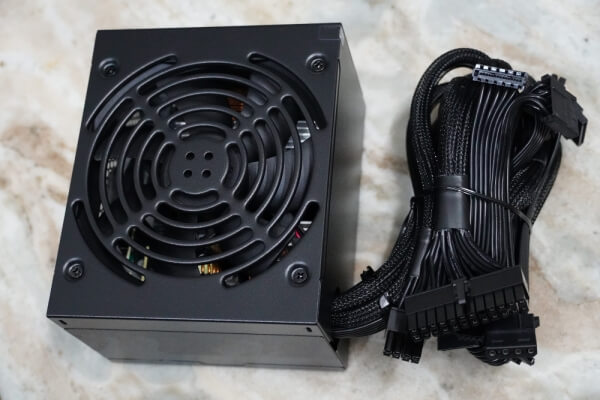
OCZ Z Series 1000 W Power Supply Review
Load Tests
Contents
We conducted several tests with this power supply, as described in the article Hardware Secrets Power Supply Test Methodology.
First we tested this power supply with five different load patterns, trying to pull around 20%, 40%, 60%, 80%, and 100% of its labeled maximum capacity (actual percentage used listed under “% Max Load”), watching how the reviewed unit behaved under each load. In the table below we list the load patterns we used and the results for each load.
If you add all the power listed for each test, you may find a different value than what is posted under “Total” below. Since each output can vary slightly (e.g., the +5 V output working at +5.10 V), the actual total amount of power being delivered is slightly different than the calculated value. On the “Total” row we are using the real amount of power being delivered, as measured by our load tester.
The +12VA and +12VB inputs listed below are the two +12 V independent inputs from our load tester. During this test both inputs were connected to the power supply single rail (+12VB input was connected to the power supply EPS12V connector and all other cables were connected to the load tester +12VA input).
| Input | Test 1 | Test 2 | Test 3 | Test 4 | Test 5 |
| +12VA | 8 A (96 W) | 14 A (168 W) | 22 A (264 W) | 30 A (360 W) | 33 A (396 W) |
| +12VB | 8 A (96 W) | 14 A (168 W) | 22 A (264 W) | 28 A (336 W) | 33 A (396 W) |
| +5V | 2 A (10 W) | 6 A (30 W) | 8 A (40 W) | 10 A (50 W) | 22.5 A (112.5 W) |
| +3.3 V | 2 A (6.6 W) | 6 A (19.8 W) | 8 A (26.4 W) | 10 A (33 W) | 22 A (72.6 W) |
| +5VSB | 1 A (5 W) | 2 A (10 W) | 2.5 A (12.5 W) | 3 A (15 W) | 3.5 A (17.5 W) |
| -12 V | 0.5 A (6 W) | 0.5 A (6 W) | 0.5 A (6 W) | 0.5 A (6 W) | 0.5 A (6 W) |
| Total | 223.9 W | 407.9 W | 619.0 W | 803.0 W | 995.2 W |
| % Max Load | 22.4% | 40.8% | 61.9% | 80.3% | 99.5% |
| Room Temp. | 45.6° C | 45.3° C | 46.9° C | 46.2° C | 48.1° C |
| PSU Temp. | 43.8° C | 45.0° C | 46.2° C | 47.6° C | 50.2° C |
| Voltage Regulation | Pass | Pass | Pass | Pass | Fail on +3.3 V |
| Ripple and Noise | Pass | Pass | Pass | Pass | Fail on -12 V |
| AC Power | 252.6 W | 455.3 W | 695.0 W | 915.0 W | 1180.0 W |
| Efficiency | 88.6% | 89.6% | 89.1% | 87.8% | 84.3% |
| AC Voltage | 115.7 V | 114.2 V | 110.7 V | 107.8 V | 104.5 V |
| Power Factor | 0.952 | 0.980 | 0.990 | 0.993 | 0.995 |
| Final Result | Pass | Pass | Pass | Pass | Fail |
Before analyzing our results, we have to explain that we were limited by our equipment. Our load tester doesn’t allow us to pull more than 33 A from each of its +12 V inputs and, because of that, we couldn’t do the 1000 W test (test five) the way we wanted. We always try to pull more from +12 V and less from +5 V and +3.3 V, because this distribution better reflects the usage of a modern PC, since the +12 V output is used to feed the CPU and the video cards. Because of this limitation we had to increase current/power on +5 V and +3.3 V above the level we would have used if our tester didn’t have such limitation.
The +3.3 V output presented 3.06 V during this test, below the minimum allowed (3.135 V). However, we should not consider this a total failure, because, as explained, we were pulling more current/power from +3.3 V than we normally do.
The good thing is that OCZ Z Series 1000 W can really deliver its labeled wattage at high temperatures, always presenting a sky-high efficiency, between 87.8% and 89.6% when we pulled up to 800 W from it. At 1000 W efficiency dropped to 84.3%, still a very decent number.
80 Plus Gold certification, however, promises that this power supply would be able to show efficiency of at least 87% under light (20%, 200 W in the case of this unit) and full (100%, 1000 W) loads, and efficiency of at least 90% under typical (50%, 500 W in the case of this unit) load. As you can see there is a gap between what is promised and what this unit can really deliver under full load, mainly because Ecos Consulting, the company behind 80 Plus certification, tests power supplies at 23° C (which we think is unrealistic) and we test power supplies with a room temperature of at least double that (efficiency drops with temperature). Click here to understand more about this problem.
Voltage regulation was very good, with all voltages within 3% of their nominal values (i.e., voltages closer to their “face value” than required by the ATX12V specification that allows a 5% tolerance for all positive voltages and 10% for -12 V). The exception was for +3.3 V during test four (at 3.19 V it was still inside the 5% margin) and five (as explained above).
Noise and ripple was always low, except on -12 V output, which passed the maximum allowed during test five (122.6 mV). Below you can see the results for the other outputs on the same test. The maximums allowed are 120 mV for +12 V and -12 V and 50 mV for +5 V and +3.3 V. All values are peak-to-peak figures.
 Figure 17: +12VA input from load tester during test five at 995.2 W (58.8 mV).
 Figure 18: +12VB input from load tester during test five at 995.2 W (55.8 mV).
 Figure 19: +5V rail during test five at 995.2 W (18.4 mV).
 Figure 20: +3.3 V rail during test five at 995.2 W (24.2 mV).
Let’s see if we could pull even more from OCZ Z Series 1000 W.