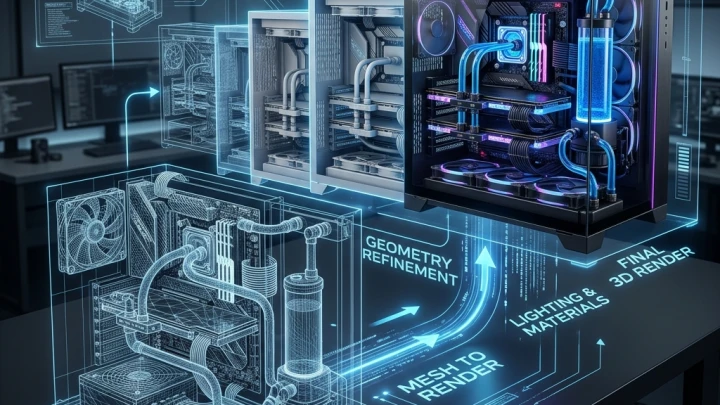
Redefining Custom PC Modding and Hardware Prototyping
The custom PC building and hardware modding communities have always pushed the boundaries of physical engineering. Enthusiasts and professional system integrators constantly seek new methods to conceptualize complex water-cooling loops, custom chassis designs, and bespoke electronic enclosures. Historically, translating a physical concept into a functional computer-aided design model required painstaking manual measurement and advanced modeling skills. The introduction of artificial intelligence in geometric processing is fundamentally upgrading this workflow. By adopting advanced spatial generation platforms, creators can now leverage AI-driven 3D modeling for PC modding to instantly digitize physical components, drastically reducing the time required for accurate prototyping and thermal simulation.
This transition from manual drafting to automated digital twin generation is powered by highly sophisticated neural networks capable of understanding depth, material properties, and complex geometries from standard video or photographic inputs. At the bleeding edge of this innovation is Neural4D, a comprehensive AI platform jointly developed by Nanjing University, DreamTech, Oxford University, and Fudan University. Through its proprietary Spatial Sparse Attention (SSA) mechanism and the highly efficient Direct3D-S2 architecture, Neural4D allows hardware engineers to rapidly convert visual data into precise, physics-ready models. This capability empowers modders to virtually test component clearances, optimize airflow dynamics, and design perfectly fitted custom hardware without committing to expensive physical manufacturing runs.
The Shift from Manual Drafting to Algorithmic Generation
For decades, custom PC modification relied heavily on traditional measurement tools. Calipers and micrometers were the primary instruments used to map out the dimensions of motherboards, graphics cards, and radiators. Once the measurements were recorded, the modder had to rebuild the component from scratch in a CAD environment. This process was highly susceptible to human error. A miscalculation of a single millimeter could result in a custom water block failing to mount or a reservoir colliding with a side panel.
Modern deep learning algorithms eliminate this manual vulnerability. By feeding a continuous video sweep or a series of high-resolution images into an AI reconstruction engine, the software mathematically infers the precise physical dimensions and contours of the object.
Core Benefits of Algorithmic Reconstruction in Hardware
- Precision Dimensional Accuracy: Advanced algorithms process millions of data points to generate highly accurate bounding boxes and vertex coordinates. This level of precision is critical when designing tightly integrated small-form-factor builds where internal volume is strictly limited.
- Material Recognition and Physics Processing: Beyond simple shape generation, modern AI models analyze how light reflects off different surfaces. They can distinguish between the brushed aluminum of a heatsink, the matte plastic of a fan housing, and the polished copper of a cold plate, automatically baking these material properties into the final texture maps.
- Rapid Iteration Cycles: Because the initial modeling phase is compressed from several days to mere minutes, designers can test multiple iterations of a custom bracket or fan shroud in a virtual environment before ever powering up a 3D printer.
Simulating Thermal Dynamics with Digital Twins
One of the most complex challenges in high-performance computing is managing thermal output. When overclocking processors or running multiple high-end graphics cards, standard air cooling is often insufficient. Custom liquid cooling loops provide superior thermal dissipation, but designing them requires meticulous planning. Fluid dynamics and heat transfer rates must be carefully calculated to prevent hardware failure.
By utilizing AI reconstruction, modders can quickly build an accurate digital twin of their entire system. Once the virtual replica is assembled, it can be exported into specialized thermal simulation software.
The Workflow of Virtual Thermal Testing
To understand how this technology is applied in real-world scenarios, consider the following procedural workflow used by modern system integrators:
- Component Digitization: The builder records a brief video of a new, unreleased motherboard layout. The AI platform processes this visual data and generates a mathematically sound mesh of the board, complete with the exact locations of VRMs, capacitors, and mounting holes.
- Spatial Assembly: The digitized motherboard is placed inside a virtual chassis. The builder then imports digitized models of radiators, pumps, and GPU blocks, arranging them to ensure zero physical collision.
- Airflow and Fluid Simulation: With all physical components accurately represented, the builder runs computational fluid dynamics software over the digital twin. This simulation reveals potential hot spots, dead airflow zones, and optimal routing paths for rigid tubing.
- Component Fabrication: Upon verifying the thermal efficiency of the design, custom mounting brackets and distribution plates are exported as manufacturing-ready files for CNC machining or 3D printing.
Expanding the Hardware Modification Ecosystem
The democratization of 3D modeling tools has fostered a massive expansion in collaborative hardware design. In the past, only heavily funded engineering firms possessed the resources to rapidly prototype and share complex electronic enclosures. Today, independent makers have access to the same level of geometric processing power.
This accessibility has fueled a vibrant, open-source hardware community. Creators routinely digitize hard-to-find components or legacy computer parts, ensuring that replacement brackets and custom modifications are available to anyone with a desktop fabricator. When a modder successfully designs a highly optimized fan duct or a modular drive cage, they can instantly distribute the file globally. For those looking to integrate these pre-optimized components into their own builds, finding reliable resources is highly important. Platforms hosting DIY3D free STL and 3MF files serve as vital repositories for the modding community, allowing builders to download, modify, and physically print structurally sound hardware parts that have been verified by other enthusiasts.
Optimizing Meshes for Manufacturing
It is critical to understand that a visual 3D model is not inherently ready for physical manufacturing. A high-polygon mesh generated purely for visual fidelity might contain non-manifold edges, inverted normals, or self-intersecting geometry. These topological errors will cause a slicing engine or CNC software to crash.
High-end AI reconstruction platforms specifically address this issue by incorporating intelligent mesh optimization algorithms.
Geometric Cleanliness and Export Standards
When the AI processes the initial point cloud, it executes a secondary routine to clean the topology. This involves automatically sealing geometric holes and recalculating surface normals to ensure the object is mathematically solid. For PC modding, this step is non-negotiable. If a modder is designing a custom mounting plate to hold a heavy water cooling reservoir, the printed part must have complete structural integrity.
Furthermore, the output formats must align with industry standards. While visual effects artists might prefer OBJ or FBX files, hardware engineers require precise dimensional formats. Advanced generation systems offer direct exports to CAD-friendly formats like STEP or STL, maintaining strict unit scaling so that a 120mm fan mount in the digital environment translates exactly to a 120mm physical object.
Defining the Next Generation of Hardware Engineering
The integration of advanced deep learning into the hardware modification pipeline is actively bridging the gap between digital conceptualization and physical reality. The days of tedious manual measurement and prolonged trial-and-error prototyping are rapidly concluding. By adopting automated reconstruction technologies, builders secure the ability to iterate designs instantly, verify thermal performance virtually, and manufacture custom components with absolute confidence.
As algorithmic precision continues to advance, the barrier to entry for highly complex hardware engineering will continue to lower. The ability to generate accurate, physics-ready digital twins from simple visual data empowers a new tier of creators to build previously impossible machines. For the custom PC and electronics communities, mastering these automated geometric workflows is the definitive path to pushing hardware performance and aesthetic design into uncharted territory.