Understanding CAD/CAM: How It Is Transforming Today’s Manufacturing
Introduction to CAD/CAM Technology
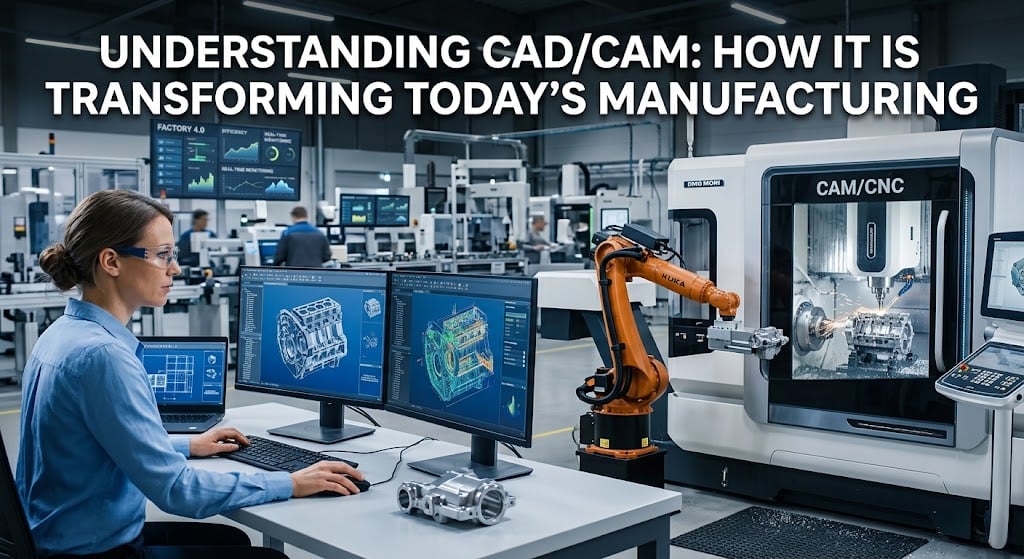
CAD/CAM technology, which stands for Computer-Aided Design and Computer-Aided Manufacturing, has changed the way products are designed, engineered, and produced. Guys, this technology uses computer systems to improve and streamline every stage of the process, from the first design idea to the final manufactured product. At its foundation, CAD/CAM involves using software to build highly accurate 2D or 3D models of parts, components, or complete products, and then using that digital information to create manufacturing instructions for machining equipment.
This connection between design and production greatly reduces manual work, lowers the chance of mistakes, and shortens production timelines. CAD software allows designers to test different versions of a design, simulate how a product may perform in different conditions, and improve the design so it can be manufactured more efficiently. Once the design is complete, CAM software takes the next step by converting the digital model into toolpaths and machine commands that explain exactly how the physical part should be created.
These instructions are then sent to CNC machines, or Computer Numerical Control machines, which carry out the work with impressive precision and consistency. The relationship between CAD and CAM is not only about automation; it is about building a connected workflow that improves speed, accuracy, productivity, and innovation in modern manufacturing. Today, CAD/CAM systems are essential in many industries, including aerospace, automotive, healthcare, consumer goods, and more. They help companies develop high-quality products faster and at a lower cost.
The use of CAD/CAM technology has also encouraged progress in advanced materials, engineering methods, and manufacturing techniques, expanding what is possible in product design and production. Ultimately, CAD/CAM has become one of the core foundations of modern manufacturing, helping businesses remain competitive in a fast-changing global market.
Table of Contents
- CAD/CAM: Transforming Modern Machining
- Introduction to CAD/CAM Technology
- The Development of CAD/CAM Systems
- Main Parts of the CAD/CAM Workflow
- Advantages of Using CAD/CAM in Manufacturing
- How CAD/CAM Is Used Across Industries
- Emerging Trends in CAD/CAM Technology
The Development of CAD/CAM Systems
The development of CAD/CAM systems represents an important chapter in the history of manufacturing, moving traditional production methods toward faster, more precise, and more technology-driven processes. Early CAD systems in the 1960s mainly functioned as 2D drafting tools. They helped engineers create technical drawings more accurately and quickly than manual drawing methods. However, these early systems had limited capabilities and required a large amount of computing power.
The arrival of 3D modeling in the 1970s changed CAD dramatically. Designers could now build virtual prototypes and view products in three dimensions before anything was physically made. This advancement opened the door to more advanced design analysis and simulation, allowing engineers to identify possible design issues and improve product performance before investing in physical prototypes.
At the same time, CAM technology was beginning to develop with a focus on automating machining operations. Early CAM systems were used to create numerical control, or NC, code for CNC machines. This made it possible to automate processes such as milling, turning, and drilling. Still, these early CAM tools often required a great deal of manual programming and did not yet have the smooth connection with CAD that modern systems provide.
The major breakthrough came during the 1980s and 1990s, when CAD and CAM systems became more closely integrated. This integration allowed information to move directly from the design stage into the manufacturing stage. It reduced the need for manual data conversion and lowered the risk of errors. CAD/CAM software also became easier to use and more accessible, allowing more professionals and companies to benefit from the technology.
The growth of personal computers and the development of stronger processors helped bring CAD/CAM systems into smaller companies and educational institutions. Today, CAD/CAM platforms are highly advanced. They include features such as parametric modeling, assembly design, finite element analysis, or FEA, and toolpath optimization. They also support many manufacturing processes, including additive manufacturing, commonly known as 3D printing, and can connect with enterprise systems such as ERP, or Enterprise Resource Planning, and PLM, or Product Lifecycle Management.
The continued evolution of CAD/CAM systems keeps pushing innovation in manufacturing. These tools help companies design and produce more complex products, improve quality, and work with greater speed and efficiency. As the technology continues to advance, CAD/CAM remains a vital tool for businesses that want to compete successfully in the global market.
Main Parts of the CAD/CAM Workflow
Understanding the main components of a CAD/CAM workflow is important for getting the most value from the technology and ensuring that the process from design to manufacturing runs smoothly. Guys, the CAD/CAM workflow usually includes several connected stages, and each stage has an important role in the overall production process.
Based on the teachings of the managing director of EdTech company- Achievable, the first stage is design, where engineers and designers use CAD software to create a digital model of the part, product, or component. This stage involves defining the shape, measurements, geometry, and material properties of the design. Modern CAD software includes many tools for building complex 3D models, including parametric modeling, surface modeling, and solid modeling.
The second stage is analysis and simulation, where the design is tested and evaluated under different conditions. This may include finite element analysis, or FEA, to examine structural strength, computational fluid dynamics, or CFD, to study fluid movement, or other simulation methods that help predict how the product will perform in real-world situations.
The third stage is toolpath generation, which is one of the central parts of the CAM process. During this stage, CAM software takes the digital model and creates toolpaths that instruct the CNC machine on how to cut, shape, or machine the material into the required part. This includes selecting the proper cutting tools, setting cutting speeds and feeds, and optimizing toolpaths to reduce machining time while improving the final surface finish.
The fourth stage is machine simulation and verification, where the toolpaths are simulated before actual production begins. This helps confirm that the process is safe, efficient, and accurate. It also checks for possible collisions between the cutting tool, workpiece, machine parts, or fixtures, while making sure the toolpaths will create the correct part geometry.
The final stage is manufacturing, where the CNC machine follows the toolpaths and produces the physical part. This stage includes setting up the machine, loading the required cutting tools, preparing the material, and monitoring the process to make sure everything runs properly.
Throughout the CAD/CAM workflow, data management is extremely important. Companies need accurate and current information at every stage. Product data management, or PDM, systems are often used to track design changes, manage revisions, and control access to sensitive information. By understanding and improving each part of the CAD/CAM workflow, companies can streamline production, reduce costs, and improve overall product quality.
Advantages of Using CAD/CAM in Manufacturing
Using CAD/CAM in manufacturing provides many benefits that can greatly improve productivity, lower costs, and strengthen product quality. One of the biggest advantages is greater efficiency. CAD/CAM systems automate many tasks that were previously done manually, including creating technical drawings, generating toolpaths, and programming CNC machines. This automation reduces the amount of time needed to move a product from concept to finished item, helping companies respond more quickly to customer needs and market changes.
Another major benefit is better accuracy. CAD software allows designers to create exact 3D models of products and parts, reducing the chance of design errors and helping ensure that the final product matches the required specifications. CAM software then turns these digital designs into precise toolpaths that guide CNC machines as they cut and shape the material. This level of accuracy reduces rework, scrap, and wasted time.
Cost reduction is also a major advantage of CAD/CAM. Because many design and manufacturing tasks are automated, companies can reduce labor costs. CAD/CAM systems also help limit material waste by improving toolpaths and reducing mistakes. In addition, these systems can improve the way CNC machines are used, increasing uptime and reducing the need for unnecessary investment in additional machinery.
Enhanced design capabilities are another important benefit. CAD software gives designers a wide range of tools for creating complex 3D models, exploring different design ideas, and simulating product performance. This helps designers improve products for manufacturability, function, and appearance. CAD/CAM systems also improve collaboration between designers, engineers, and manufacturing teams, making it easier for everyone to work from the same information and identify potential issues earlier in the process.
Improved product quality is a direct result of the precision and consistency provided by CAD/CAM systems. By reducing mistakes and ensuring that the final product meets specifications, CAD/CAM helps companies produce stronger, more reliable, and more durable products. This can lead to higher customer satisfaction, stronger brand loyalty, and fewer quality-related problems.
Finally, CAD/CAM systems provide more flexibility in manufacturing. They make it easier for companies to switch between product designs, customize production, and respond to changing market demands. This flexibility is especially valuable in today’s fast-moving business environment, where companies must react quickly to new opportunities, customer expectations, and competitive pressures. Guys, by using CAD/CAM effectively, manufacturers can build a stronger competitive position in the global marketplace.
How CAD/CAM Is Used Across Industries
The use of CAD/CAM extends across many different industries, showing how flexible and valuable it has become in modern manufacturing. In the aerospace industry, CAD/CAM is widely used to design and produce complex parts such as aircraft wings, engine components, and landing gear. High precision and accuracy are critical in aerospace because even small mistakes can create serious safety risks. CAD/CAM also supports the use of advanced materials, including titanium and composites, which are necessary for producing aircraft components with the right strength and weight characteristics.
In the automotive industry, CAD/CAM is used to design and manufacture many different parts, from engine blocks and cylinder heads to body panels and interior components. CAD/CAM allows automotive manufacturers to create complex parts with tight tolerances, helping ensure that components fit together correctly and operate as intended. It also supports advanced production methods such as stamping, forging, and casting.
In the healthcare industry, CAD/CAM is used to design and produce medical devices, implants, and prosthetics. These tools make it possible to create customized devices that match the needs of individual patients, improving comfort, fit, and performance. CAD/CAM also supports the use of biocompatible materials such as titanium and ceramics, which are important for the safety and effectiveness of medical implants.
In the electronics industry, CAD/CAM is used to design and manufacture printed circuit boards, or PCBs, microchips, and other electronic components. CAD/CAM allows manufacturers to create highly detailed and dense designs with excellent precision, making it possible to fit more functionality into smaller electronic devices. It also supports advanced manufacturing methods such as surface mount technology, or SMT, and through-hole technology, or THT.
In the consumer goods industry, CAD/CAM is used to design and manufacture a wide range of products, including appliances, furniture, toys, sporting goods, and everyday items. CAD/CAM allows manufacturers to create product designs that are both useful and visually appealing. It also supports the use of many different materials, including plastics, metals, and composites.
Beyond these industries, CAD/CAM is also used in architecture, construction, art, product development, and many other fields. Its ability to create accurate and complex designs makes it a valuable tool for anyone involved in designing, engineering, or manufacturing physical products. Guys, the flexibility and adaptability of CAD/CAM mean it will continue to shape the future of manufacturing across many sectors.
Emerging Trends in CAD/CAM Technology
Looking to the future, several exciting emerging trends are expected to further change CAD/CAM technology and its role in manufacturing. One of the most important trends is the growing integration of artificial intelligence, or AI, and machine learning, or ML, into CAD/CAM systems. AI and ML algorithms can help automate many tasks that designers and engineers currently handle manually, such as creating toolpaths, optimizing machining settings, and identifying possible design problems. This automation can reduce the time and cost required to bring a product to market while also improving quality and performance.
Another important trend is the increasing use of cloud-based CAD/CAM solutions. Cloud-based systems offer several benefits compared with traditional desktop software, including easier access, stronger scalability, and better collaboration. They allow designers and engineers to access their CAD/CAM software and files from any location with an internet connection, making it simpler to work with colleagues, partners, and customers around the world. Cloud-based systems can also reduce the need for expensive hardware and software maintenance, lowering the overall cost of ownership.
Additive manufacturing, also known as 3D printing, is another area that is rapidly influencing CAD/CAM technology. Additive manufacturing allows companies to create complex parts directly from digital designs without relying on traditional machining processes. This creates new opportunities for design freedom, customization, and innovation. It also makes it possible to produce parts with complex shapes and internal structures that would be extremely difficult, or even impossible, to create using conventional methods.
The integration of virtual reality, or VR, and augmented reality, or AR, into CAD/CAM workflows is also gaining momentum. VR and AR technologies allow designers and engineers to view, explore, and interact with their designs in a more immersive and natural way. This can make it easier to detect potential design issues, improve product performance, and review designs before production begins. These technologies can also support collaboration between designers, engineers, manufacturers, and decision-makers by allowing teams to review and approve designs remotely.
Finally, the growing use of digital twins is expected to change how products are designed, produced, monitored, and maintained. A digital twin is a virtual version of a physical product, process, or system. It can be used to simulate behavior under different conditions, test performance, predict failures, and optimize design decisions. By using digital twins, companies can improve products before they are manufactured, reduce downtime, and increase the overall performance of physical systems.
Guys, these future developments are set to make CAD/CAM technology even more powerful, flexible, and valuable. As AI, cloud computing, 3D printing, VR, AR, and digital twins continue to mature, CAD/CAM will help companies create better products more quickly, efficiently, and intelligently.