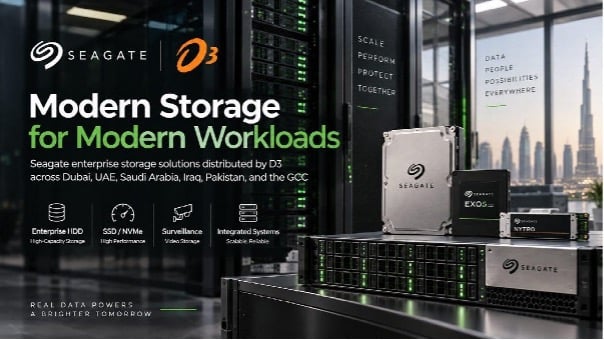
Modern Storage for Modern Workloads
Most businesses deal with several very different data storage requirements at the same time. Virtual machines need quick, consistent access to data, while databases are far more sensitive to delay and I/O performance. Backup systems steadily consume more capacity as data accumulates, and surveillance platforms may be writing multiple video streams 24 hours a day.
Treating all of that as one generic “storage requirement” is where infrastructure planning starts to go wrong.
Capacity still matters, but it is only one part of the decision. Performance, endurance, workload profile, physical density, availability, and expected growth all affect which storage technology belongs in a given system. That is why enterprise storage portfolios such as Seagate’s now span high-capacity HDDs, enterprise SSDs and NVMe drives, surveillance-specific storage, and integrated storage platforms rather than relying on one type of device for every job. For organizations building around these technologies, working with the right Seagate distributor can also help match product selection, sizing, and availability to the workload itself.
Modern Workloads Need Different Storage
The HDD-versus-SSD argument is much less useful in an enterprise environment than it is in a desktop upgrade discussion.
A high-capacity backup repository has very different priorities from a database handling frequent transactions. A large NVR installation does not behave like a virtualization cluster. An archive may favor capacity and cost per terabyte, while an application server can be far more sensitive to latency.
The practical question is therefore not whether HDD or SSD is “better.” It is which storage technology best fits the workload.
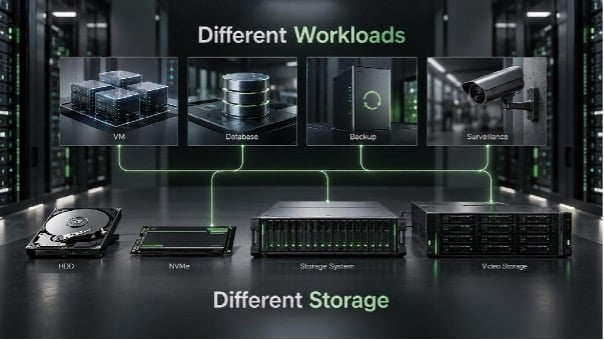
Hard drives continue to make sense where organizations need large amounts of online capacity at an economical cost per terabyte. SSDs and NVMe storage become attractive where application response, IOPS, and predictable latency have greater value. Many enterprise environments use both, assigning each storage tier the work it handles best.
This workload-first approach also makes capacity planning more useful. Buying the largest available drive is not a storage strategy if the surrounding servers, network, application pattern, or retention requirements point in another direction.
Capacity Is Still a Serious Engineering Problem
Faster storage has not slowed the growth of the data itself. Backup repositories keep expanding, analytics platforms retain larger datasets, and private-cloud environments accumulate more information over time. AI workloads add even more pressure, especially where large volumes of data need to be stored, processed, and kept accessible.
Seagate Exos® enterprise hard drives are built for this side of the problem. The current Exos family is positioned for high-capacity enterprise and data-center environments, with Seagate emphasizing storage density, always-on operation, scalability, and compatibility via standard infrastructure. Seagate’s newer Exos designs also use its Mozaic platform and HAMR technology to increase areal density.
HAMR, short for Heat-Assisted Magnetic Recording, was developed to increase the amount of data that can be stored on a hard drive without sacrificing recording stability. At data-center scale, that extra density has practical value. Higher-capacity drives can reduce the number of racks needed for a given amount of storage, which in turn can cut demands on floor space, power, cooling, cabling, and ongoing management.
That makes high-capacity HDDs particularly relevant for data centers, private clouds, large backup repositories, and other systems where the storage footprint can become a cost in its own right.
D3 includes Exos within its Seagate enterprise storage portfolio for customers operating these types of environments. The distributor’s role becomes useful at the planning stage, where required capacity has to be considered alongside rack density, workload growth, and the wider server architecture rather than treated as a standalone purchasing figure.
When Latency Matters More Than Terabytes
There are workloads where adding capacity does little to solve the actual bottleneck.
Virtualized infrastructure can create large numbers of concurrent I/O requests. Databases may depend on quick access to relatively small pieces of data. Analytics, cloud services, and business applications can become noticeably slower when storage latency rises under load.
This is where Seagate Nytro® enterprise SSDs fit into the portfolio. The Nytro range includes enterprise SATA and NVMe products designed around data-center performance, predictable latency, throughput, and continuous operation. Current NVMe models target workloads such as virtualization, analytics, and databases, where flash storage can deliver much better performance for these workloads than capacity-oriented HDD storage.
That does not mean every enterprise dataset should move to NVMe. Doing so can raise the cost of storing information that does not need that level of performance.
A better design separates performance-sensitive data from capacity-heavy data. Nytro SSD or NVMe storage can serve active applications and high-I/O workloads, while Exos HDDs handle datasets in which density and cost per terabyte deserve more weight.
The result is often a more balanced storage architecture than simply specifying the fastest media everywhere.
Surveillance Storage Has Different Rules
Video surveillance is a good example of why workload characteristics matter.
A conventional office PC may spend much of its time reading existing data. A surveillance recorder can spend most of its working life accepting multiple continuous video streams. Add higher-definition cameras, longer retention periods, and video analytics, and the storage system has a very specific job to perform.
Seagate SkyHawk™ drives are designed for video and surveillance systems, including continuous recording in NVR environments. SkyHawk AI extends that focus to systems processing AI-enabled video streams and analytics. Seagate currently positions the family around sustained surveillance workloads rather than ordinary desktop storage patterns.
For installers and enterprise security teams, these requirements need to be worked out before the hardware is selected. The number of cameras, recording bitrate, retention period, recording schedule, and redundancy model all shape the amount of storage a system needs. Video analytics can push those requirements higher still.
D3 supplies SkyHawk solutions as part of its Seagate portfolio for CCTV, NVR, and larger surveillance projects. Here, correct sizing matters as much as product selection. Underestimating retention requirements can leave a technically capable surveillance system unable to keep the amount of footage the organization actually needs.
Scaling Past Individual Drives
Once storage reaches a certain scale, choosing individual drives is only part of the job.
Larger deployments have to account for enclosures, controllers, data protection, maintenance, and day-to-day management. The design also needs to scale cleanly, so routine servicing does not create avoidable downtime as capacity grows.
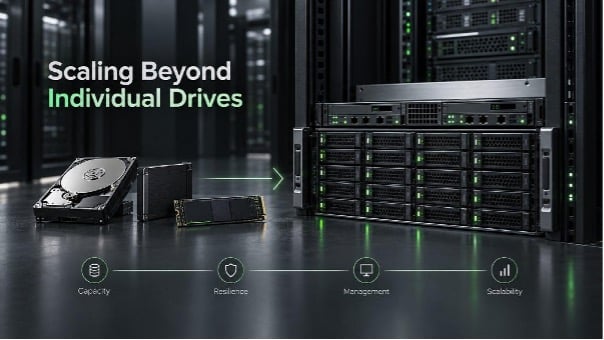
Seagate Exos CORVAULT™ handles this larger infrastructure layer. Seagate describes CORVAULT as self-managed storage with built-in data protection, with designs focused on high density, simplified management, serviceability, and drive reliability. The platform combines Seagate drives with an integrated enclosure and storage-management architecture rather than leaving customers to assemble every element independently.
For centralized storage, large data repositories, and data-center deployments, that integrated approach can simplify a project that would otherwise involve several separate design decisions.
It also changes the purchasing conversation. The question becomes less about “which drive should we buy?” and more about capacity targets, host connectivity, application requirements, protection strategy, expansion plans, and compatibility with the infrastructure already in place.
That is also where a technical distributor becomes more relevant.
Why the Distributor Is Part of the Storage Decision
Enterprise storage can be specified correctly on paper and still become a difficult project in practice.
The wrong capacity assumptions can result in expensive overprovisioning or an early upgrade. A performance tier may be undersized. Storage can be selected without enough attention to server or virtualization compatibility. Multi-site projects introduce delivery and coordination problems that have little to do with the drive specification itself.
D3 is an authorized Seagate distributor serving enterprise customers and partners in Dubai and the UAE, Saudi Arabia, Iraq, Pakistan, and across the wider GCC. Its Seagate offering combines product distribution with pre-sales consultation, workload sizing, capacity planning, architecture alignment, logistics, and B2B account management.
That distinction is useful. D3 Distributor services are aimed at helping customers decide how Seagate storage fits into the wider infrastructure before procurement is finalized.
A storage assessment may need to consider:
- expected capacity growth and retention requirements;
- latency, IOPS and application behavior;
- server, virtualization and data-center compatibility;
- project location, fulfillment schedules and future expansion.
For buyers looking for a Seagate distributor in Dubai, access to local product supply is valuable, but access to technical information is equally important. D3 can align Seagate Exos, Nytro, SkyHawk, and integrated storage systems with the workload the organization is actually trying to support.
The same approach applies to regional projects. D3 supports Seagate deployments for organizations in the UAE and Saudi Arabia while also serving customers and partners in Iraq, Pakistan, and the wider GCC. A D3 Distributor relationship can give multi-location projects a more consistent procurement path instead of treating each market as an isolated hardware purchase.
Building Storage Around the Workload
Modern storage architecture works best when the workload leads the specification.
High-capacity data does not automatically need flash. A latency-sensitive application should not be designed around cost per terabyte alone. Surveillance deserves storage built for its recording pattern, while very large deployments may be better served by an integrated storage system rather than a collection of individual drives.
Seagate covers these workloads with different product families rather than trying to fit every use case into the same type of storage. Exos is aimed at high-capacity enterprise environments, Nytro handles SSD and NVMe workloads where performance matters, SkyHawk is built around video surveillance, and Exos CORVAULT targets larger, high-density storage deployments.
The remaining task is choosing and deploying them correctly.
For enterprises and solution partners operating across Dubai, the UAE, Saudi Arabia, Iraq, Pakistan, and the GCC, D3 Distributor provides a regional route to Seagate storage backed by sizing, architecture support, and structured project fulfillment. That combination of appropriate hardware, realistic planning, and reliable regional supply is what turns storage capacity into infrastructure that can actually support the workload placed on it.
Frequently Asked Questions
What type of Seagate storage is best for data centers?
The answer depends on the workload. Seagate Exos enterprise HDDs suit environments that focus on high capacity, storage density, and economical cost per terabyte. Seagate Nytro SSD and NVMe products are better suited to workloads where latency, IOPS, and application response are more important. Large centralized deployments may also use integrated Exos storage systems such as CORVAULT.
What is the difference between Seagate Exos and SkyHawk?
Exos and SkyHawk are built for very different jobs. Seagate Exos drives are aimed at enterprise and data-center environments, where high capacity, sustained operation, and large storage pools are common. SkyHawk is designed specifically for surveillance systems, with workloads centered on continuous video recording. SkyHawk AI is intended for installations that also process AI-assisted video and analytics.
When should an enterprise choose NVMe instead of HDD storage?
NVMe is a strong choice for workloads where storage speed can noticeably affect the application. Databases, virtual machines, and analytics platforms usually fall into this group because they depend on quick access to data and consistent response times.
HDDs still have a clear place in enterprise storage. Backup repositories, archives, and other big datasets usually care more about usable capacity and cost per terabyte than they do about the fastest possible response times.
That is why HDDs and NVMe often end up in the same environment rather than competing for the same role. Flash handles the workloads that need speed, while hard drives take care of the data that simply needs to be stored efficiently at scale.
Where can businesses source Seagate enterprise storage in Dubai and the GCC?
D3 is an authorized Seagate distributor with operations serving Dubai and the UAE, Saudi Arabia, Iraq, Pakistan, and the wider GCC. The D3 Seagate Distributor offering covers Exos enterprise HDDs, Nytro SSD and NVMe products, SkyHawk surveillance drives, and integrated storage systems, together with technical consultation, sizing, architecture support, and regional project fulfillment.