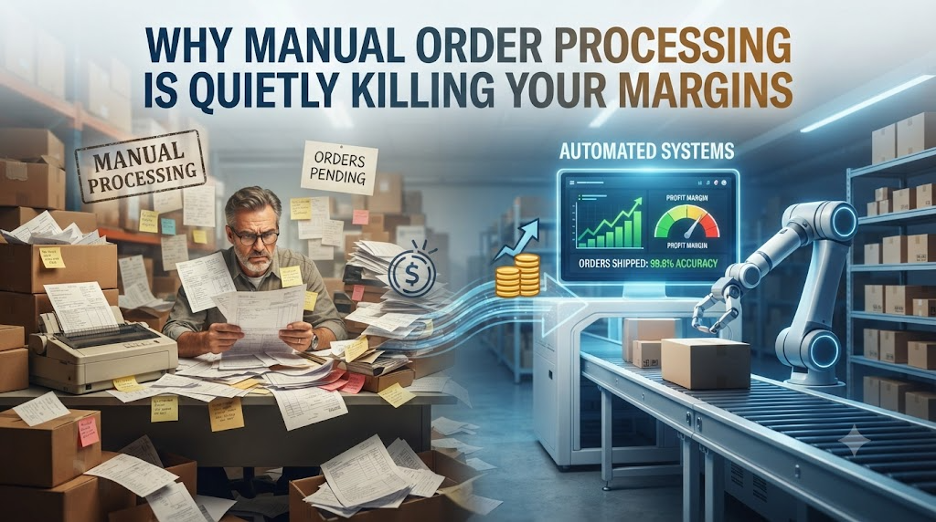
Why Manual Order Processing Is Quietly Killing Your Margins
Every growing ecommerce brand and wholesale distributor eventually hits a critical tipping point. Revenue is climbing, order volumes are surging, and the internal team is celebrating steady expansion yet bank accounts and operating profit margins feel tighter than ever before.
Behind the scenes, the culprit is rarely lack of sales volume, rising customer acquisition costs, or inefficient marketing spend. Instead, it is a silent profit killer hiding in plain sight: manual order processing.
When a business relies heavily on spreadsheets, manual data entry, and human intervention to push orders from a storefront into an ERP or warehouse management system, growth creates compounding operational friction. Systems that work seamlessly at 50 orders a day break down completely at 500 or 5,000 orders a day. Errors multiply, fulfillment windows stretch out, and labor costs skyrocket, steadily eroding the very financial margins your expansion was designed to secure.
The Breaking Point of Manual Operations
As modern distribution channels expand across direct-to-consumer Shopify stores, B2B wholesale portals, and multi-vendor marketplaces, order entry transforms into a severe operational bottleneck.
- Human Error Costs Real Money: Manually rekeying complex SKUs, customer shipping addresses, and quantities leads to common keyboard typos, mis-ships, and costly return processing that drains customer lifetime value.
- Delayed Fulfillment Windows: When daily orders sit in a stagnant queue waiting for manual data verification, credit checks, or inventory lookups, same-day shipping commitments become impossible to maintain.
- Spiraling Labor Overhead: Hiring additional data entry personnel just to keep pace with baseline order volume eats directly into operating profits rather than scaling your business efficiently.
- Inventory Blind Spots: Manual workflows cannot update stock levels in real-time across multiple channels, frequently resulting in overselling, frustrated customers, and canceled transactions.
Scaling a modern distribution or ecommerce business requires systematically removing human friction from the entire order lifecycle. This is precisely where modern supply chains pivot from manual grind to automated, data-driven intelligence.
How AI Transforms Order Processing and Fulfillment
Solutions from the team behind Momentacom show how artificial intelligence does much more than simply digitize documents or create digital folders; it automates comprehension, intelligent decision-making, and routing across your entire technology stack. Modern platforms ingest unstructured incoming data such as scanned PDF purchase orders, customer service emails, and legacy EDI feeds instantly translating them into fully validated, ready-to-ship orders.
What Is Actually Automated?
- Intelligent Document Capture: Advanced machine learning extracts line items, quantities, and specific delivery instructions from messy incoming files without requiring rigid, pre-built templates.
- Automated Inventory Allocation: Real-time stock checks across multiple warehouses happen instantly before the order ever reaches the physical warehouse floor, preventing allocation conflicts.
- Dynamic Exception Handling: Instead of halting operations for an ambiguous address or a temporary stockout, the system flags only the specific exception for human review while processing the rest automatically.
- Smart Carrier Selection: Complex algorithms evaluate real-time shipping rates, guaranteed delivery speeds, and historical carrier performance to choose the optimal shipping method for every single package.
Manual vs. AI-Driven Processing: A Quick Comparison
| Feature | Traditional Manual Processing | AI-Driven Fulfillment |
| Order Entry Speed | Hours or days (dependent on human backlog) | Instantaneous ingestion and validation |
| Error Rate | High (susceptible to keyboard and transcription typos) | Near-zero (machine-verified data extraction) |
| Labor Requirement | High reliance on dedicated data-entry headcount | Minimal; staff shift to high-value exception management |
| Order Capacity | Strictly limited by staff working hours and typing speed | Scales infinitely with seasonal demand surges |
| Fulfillment Cost per Order | Rises as order volume and labor needs grow | Decreases significantly through operational leverage |
The True Cost of Inventory Inaccuracies and Processing Delays
When orders stall in manual pipelines, the downstream consequences affect every department in the enterprise. Customer service teams spend hours fielding phone calls and emails asking, “Where is my order?” Warehouse staff waste valuable time correcting pick lists caused by outdated data entry. Meanwhile, management loses visibility into real-time demand trends, making accurate forecasting nearly impossible.
By eliminating manual checkpoints, businesses unlock operational agility. Orders flow uninterrupted from the digital cart straight to the packing station. This acceleration does not just cut labor costs it fundamentally elevates customer satisfaction and repeat purchase rates, driving sustainable long-term revenue growth.
What to Look for When Evaluating an Automation Platform
Evaluating tech solutions for your supply chain requires looking past flashy marketing claims and focusing on core capabilities that integrate cleanly into your existing business ecosystem.
When assessing options, prioritize platforms that offer:
- Deep ERP and WMS Integrations: The software must synchronize seamlessly with your existing tech stack (such as NetSuite, Shopify Plus, or SAP) without creating dangerous data silos.
- Robust Exception Workflows: Look for intuitive dashboards that quickly highlight validation failures so your team can resolve them in seconds rather than hunting through endless spreadsheets.
- Scalability and Speed: Ensure the platform handles high-volume seasonal spikes (like Black Friday or major B2B catalog drops) without latency or system crashes.
- Transparent Implementation Support: Leverage expert implementation services and robust support teams to deploy fully customized workflows tailored specifically to your unique distribution model without friction.
Frequently Asked Questions
How long does it take to implement an AI order processing system?
Implementation timelines vary depending on your existing ERP architecture and the complexity of your order channels, but most modern platforms can be integrated and fully configured within a few weeks.
Will AI replace our existing customer service and warehouse staff?
No. Automation handles repetitive data entry and routine transactional workflows, freeing up your team to focus on high-value tasks like client relationships, exception resolution, and strategic business expansion.
Can AI handle unstructured purchase order formats from different B2B buyers?
Yes. Modern machine learning models are explicitly designed to read and parse varying PDF layouts, email bodies, and legacy document formats without needing manual template creation for every new client account.
Conclusion
Growth should feel like an achievement for your business, not an operational crisis. When manual data entry, disconnected spreadsheets, and sluggish workflows trap your order fulfillment in a constant state of catch-up, profit margins inevitably suffer.
Transitioning to an AI-powered fulfillment infrastructure removes these hidden roadblocks, replacing human error and administrative drag with speed, accuracy, and scalability. By letting modern technology handle the heavy lifting of order ingestion and processing, your team can finally shift its focus away from putting out fires and back toward scaling the business.