How Smart Gas Leak Detectors Work: Sensors, Electronics, and Selection Tips
Gas leaks give few warnings. Methane and propane have no natural odor of their own, and carbon monoxide has none at all. This is why gas detection has moved beyond the simple battery alarm bolted to a wall. Today’s smart, WiFi-connected detectors combine gas sensing hardware with embedded electronics and cloud connectivity, turning a single safety device into a small IoT system. Understanding how these gas leak detectors actually work, from the sensor element to the app notification, helps buyers ask better questions and avoid choosing a unit based on price alone. This article breaks down the sensing technology, the internal electronics, and the practical factors that separate a reliable smart gas leak detector from a gimmick.
How Gas Sensors Detect Dangerous Leaks
Every gas leak detector starts with a sensing element that reacts physically or chemically to the target gas. The three technologies used most often in residential and light commercial detectors are semiconductor (MOS) sensors, electrochemical cells, and NDIR (non-dispersive infrared) sensors.
Semiconductor sensors use a metal oxide surface that changes electrical resistance when combustible gas molecules are present. They are inexpensive and respond quickly, which makes them common in detectors built for methane, natural gas, and LPG. Electrochemical sensors work differently: gas reacts at an electrode and produces a small current proportional to concentration. They offer strong selectivity, which is why they dominate carbon monoxide detection. NDIR sensors measure how gas absorbs infrared light at a specific wavelength. They cost more but hold their calibration well over time, so they tend to appear in detectors covering CO2 and some hydrocarbon gases.
No sensor type is universally “best.” The right choice depends on the target gas, the required accuracy, and the budget.
| Sensor Type | Best For | Advantages | Limitations |
| MOS (Semiconductor) | LPG, methane, general combustible gases | Low cost, fast response | Cross-sensitivity to other gases |
| Electrochemical | Carbon monoxide (CO) | High selectivity | Limited sensor lifespan |
| NDIR (Infrared) | CO2, some hydrocarbons | Stable long-term accuracy | Higher cost, larger size |
Inside a WiFi Gas Leak Monitor: The Electronics Behind Smart Detection
The sensor is only the first link in the chain. What separates a smart gas leak detector from a standalone alarm is everything that happens after the sensor produces a signal.
The raw output from a gas sensor is a small, noisy analog voltage. An analog front end (AFE) conditions this signal, filtering electrical noise and amplifying it to a usable range. From there, an analog-to-digital converter (ADC) turns the signal into digital data the system can process.
The microcontroller (MCU) is the brain of the device. Rather than watching the signal in real time, it samples the digital data at short, regular intervals, often every few seconds, and compares each reading against a calibrated threshold. For methane, that threshold is commonly set around 6% LEL (Lower Explosive Limit), a conservative margin well below the concentration where ignition risk becomes serious. The MCU also applies filtering logic to reduce false alarms: cooking fumes, cleaning chemicals, and humidity swings can all mimic a gas signature for a moment, so time-based checks make sure a brief spike does not trigger an unnecessary alert.
Once the MCU confirms a genuine reading, it hands off to the WiFi module, typically a 2.4GHz 802.11 b/g/n radio, which connects to the home network and pushes data to a cloud service or companion app. This is what enables a remote notification instead of just a local siren.
Power management runs quietly behind all of this. Most WiFi gas leak detectors are designed to stay powered continuously, usually through a wired 5V supply, since a gas sensor and radio module draw more current than a coin-cell battery can sustain. Continuous power also means the device is always sampling rather than waking up periodically, which matters for a safety product.
Put together, the signal path looks like this: sensor, signal conditioning, ADC, MCU processing, WiFi module, cloud or app. Each stage exists to turn a raw chemical reaction into a reliable, actionable alert.
How the Full System Works, End to End
A smart gas leak monitor follows a consistent sequence. The sensor detects gas above a set threshold, usually expressed as a percentage of the Lower Explosive Limit (LEL). The MCU verifies the reading is sustained, not a momentary spike, then triggers a local alarm through sound, light, or a voice prompt. At the same time, it sends a push notification through the WiFi connection so the alert reaches a phone even when no one is in the room.
This two-layer response, local and remote, is the main practical advantage over a traditional gas alarm. A basic alarm only helps someone who is already home and within earshot.
Key Features to Consider When Choosing a Smart Gas Leak Detector
Once the underlying technology is clear, comparing products becomes more straightforward. Looking at how specialized brands like GasDog structure their smart detectors highlights the practical features that matter most:
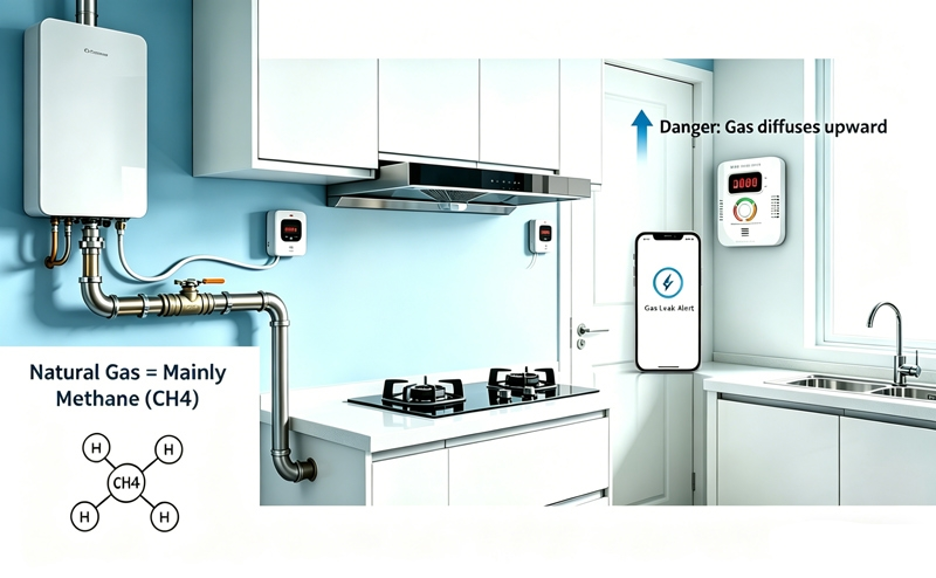
- Supported gas types: methane and natural gas rise, so detectors for these gases are typically mounted higher on a wall or ceiling. LPG is heavier than air and settles low, so LPG detectors belong closer to the floor.
- Response time: manufacturers often list a response time under 30 seconds. Faster is not automatically better. A very sensitive sensor with weak filtering reacts quickly to real leaks, but also to cooking fumes and aerosol sprays, producing frequent false alarms that erode trust in the device.
- Connectivity and app support: check whether the detector integrates with an existing smart home ecosystem or needs a separate app, and whether alerts still arrive over mobile data, not just WiFi.
- Certifications: CE, FCC, or UL marks are a reasonable baseline indicator of electrical safety testing.
- Power and reliability: confirm whether the unit runs on a wired supply, a battery, or both, and how it behaves during a WiFi outage.
Common Installation Mistakes
Even a well-built detector underperforms if it is installed poorly. The most frequent mistake is placing a methane or natural gas detector too low, where the lighter gas never reaches it. The reverse applies to LPG detectors mounted near the ceiling. Detectors placed too close to stoves, ovens, or bathrooms also pick up cooking steam and humidity, leading to nuisance alarms. As a general rule, install combustible gas detectors away from doors, windows, and vents that could dilute a leak before it reaches the sensor, and test the unit monthly using the manufacturer’s test function.
Conclusion
A smart gas leak detector is really a small, purpose-built IoT device: a chemical sensor paired with signal processing, a microcontroller, and a wireless radio. Understanding this chain, from sensor chemistry to cloud notification, makes it easier to evaluate a detector on its actual engineering rather than on marketing claims alone. As connected safety hardware becomes more common in homes and small facilities, buyers who understand what is happening inside the box will be better equipped to choose a detector that performs when it matters.