How to Choose a 24V BLDC Motor: Understanding Torque, Controllers, and Applications
Modern hardware projects ask a lot from their motors. Robots, desktop CNC machines, and small automation systems all need power that is efficient, long-lasting, and compact. That is why 24V BLDC motors have become something of a default choice in this space.
But choosing the right one is not always simple. Engineers, makers, and hardware developers often run into trouble matching torque, controllers, and feedback types. This guide walks through the fundamentals, one step at a time, so you can make a confident choice rather than a guess.
Whether you are building a robot arm, upgrading a desktop CNC machine, or specifying motors for a small automated system, the same basic questions apply. How much torque do you actually need? How will the motor sense its position? And does your controller have enough margin to handle real-world surprises? By the end of this guide, you should be able to answer all three with confidence.
Why BLDC Beats Brushed Motors
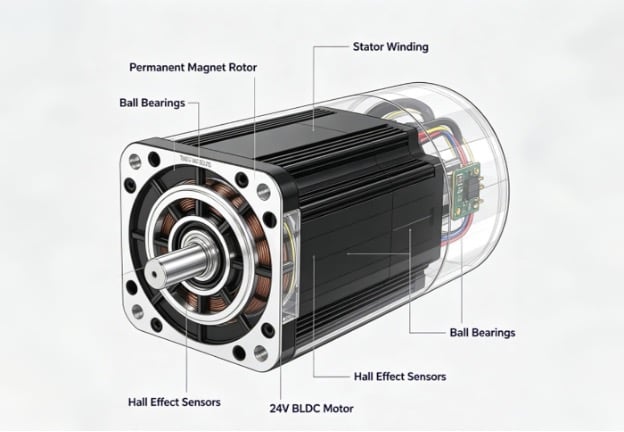
Brushless DC (BLDC) motors replace mechanical carbon brushes with electronic commutation. This one change removes friction, brush sparks, and much of the wear that shortens a brushed motor’s life. It also reduces electrical noise, though good driver design still matters here.
When starting your 24V BLDC motor selection, you will encounter two primary physical layouts:
- Inrunner motor: higher speed, lower torque. Good for compact, high-speed enclosed systems.
- Outrunner motor: lower speed, higher torque. Good for direct-drive setups and robot joints.
BLDC motors also handle heat better. Because the heat-generating windings sit in the stator, which is the stationary outer part, that heat has a shorter path to the motor casing and out into the air.
There is also a lifespan story worth mentioning. Brushed motors wear down their brushes over time, which means periodic maintenance and eventual replacement. A BLDC motor has no brushes to wear out, so the main limits on its life become bearings and winding insulation. In practice, this often means far longer service intervals, which matters a great deal in equipment that runs continuously.
The 24V Sweet Spot: Voltage vs. Efficiency
Why choose a 24V BLDC motor over a 12V or 48V alternative? The answer starts with a simple relationship: power equals voltage times current.
At the same power level, doubling the voltage cuts the current in half. Lower current means less resistive heating in the wires, so you can use thinner cables and smaller MOSFETs on the BLDC motor controller board. That keeps both cost and complexity down.
Going higher, say to 48V, brings its own tradeoffs. Higher voltage systems need more careful insulation and safety design. 24V DC sits in a comfortable middle ground for low-voltage control systems. It simplifies power management and keeps safety design straightforward, which is exactly why it shows up so often in desktop and battery-powered equipment.
Consider a simple example. A 100W motor running at 12V draws roughly 8.3A. The same 100W BLDC motor running at 24V draws about 4.2A, or roughly half the current. Less current means less heat in the wiring harness and the controller’s power stage, which is why so many manufacturers settle on 24V as their default platform for mid-sized equipment.
Key Parameters When Selecting a 24V BLDC Motor
A 24V BLDC motor’s wattage rating tells you very little on its own. Real selection depends on how several numbers work together for your specific job.
| Parameter | What to Check |
| Voltage & Power | Rated wattage under real load, not just the datasheet peak. |
| Speed (RPM) | No-load speed versus speed under your actual working torque. |
| Continuous Torque | The torque the motor can hold all day without overheating. |
| Peak / Stall Torque | Short bursts for starts, jams, or sudden load spikes. |
| Current Rating | Winding and controller current draw, which drives heat and controller size. |
| Frame Size | Mounting pattern and bolt spacing, often NEMA 23 or NEMA 34. |
Torque deserves special attention. Continuous torque is what the motor can sustain for hours without overheating. Peak or stall torque is what it can deliver for a few seconds, which matters when a robot arm starts moving or a CNC bit bites into material. Both numbers matter, and neither one alone tells the full story.
Frame size is easy to overlook, but it shapes the whole build. NEMA 23 and NEMA 34 are common mounting standards, and they describe bolt patterns and shaft dimensions rather than performance. Two motors with the same frame size can have very different torque ratings, so use frame size to confirm mechanical fit, not to judge power.
How BLDC Controllers Drive Motor Performance
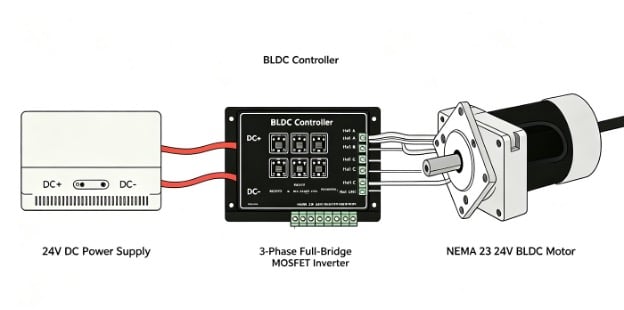
A BLDC motor cannot simply be wired to a battery. It needs three-phase power delivered in the right sequence, and that is the BLDC motor controller’s job.
Inside most BLDC motor controllers sits an inverter bridge built from six MOSFETs. These switch on and off in a coordinated pattern, energizing phases A, B, and C in turn. This is what creates the rotating magnetic field that spins the motor.
The controller also manages speed through pulse-width modulation, or PWM. By adjusting the duty cycle, essentially how long each pulse stays on, the controller can smoothly control voltage and current, and with them, motor speed.
BLDC motor controller sizing matters just as much as motor sizing. A BLDC controller that is rated close to your motor’s peak current will run hot and may shut down under load. Give yourself headroom, both in current rating and in heat sinking, so the controller can absorb short overloads without tripping or degrading over time.
Sensored vs. Sensorless: Choosing Your Feedback System
A 24V BLDC motor needs to know where its rotor is at all times so the controller can fire the right phases. There are two common ways to do this.
Sensored (Hall Effect Sensors)
Three small Hall sensors read the rotor’s position directly. This gives excellent low-speed torque and a smooth start from a complete stop. It is the better choice for robotic arms, AGVs, small mobile robots, and any system that needs precise, low-speed motion control.
Sensorless (Back-EMF Detection)
Instead of sensors, the controller reads the back electromotive force from the unpowered phase to estimate rotor position. This means fewer wires, lower cost, and better reliability in harsh or wet environments. The tradeoff is weaker performance at low speed. Fans, pumps, and high-speed drones are natural fits.
As a quick rule: if your application needs to start smoothly from a dead stop, or needs precise control at very low speed, choose sensored. If your application spends most of its time at moderate-to-high speed and values simplicity and cost savings, sensorless is usually the better fit.
Matching Motor, Controller, and Application
Once you know the parameters and the feedback type, it is time to match everything to the job at hand.
- Robotics and actuators: frequent starts and stops call for a 24V sensored motor paired with a controller that has strong current response.
- Desktop CNC auxiliary axes: feeders and positioning mechanisms benefit from steady torque, often in NEMA 23 or NEMA 34 frame sizes.
- Small automation and AGVs: battery-powered mobile systems gain the most from 24V’s lower current draw and longer runtime.
A good rule of thumb: choose a controller with headroom on both continuous and peak current. That margin is what keeps MOSFETs from failing the first time your system hits an unexpected load.
It also helps to think about duty cycle. A motor that runs continuously needs a different thermal strategy than one that only runs in short bursts. If your application involves frequent starts and stops, budget for extra cooling or a larger frame size, even if the average power draw looks modest on paper.
Common Selection Mistakes to Avoid
- Looking only at wattage, while ignoring how torque and speed actually behave under load.
- Skipping the controller’s current margin, which leads to nuisance shutdowns or burned components under heavy loads.
- Choosing a sensorless motor for a job that needs precise low-speed positioning, such as a robot joint.
- Ignoring thermal limits during continuous operation. Many BLDC failures come from heat buildup, not from a single power spike.
Conclusion and Quick Checklist
A 24V BLDC motor is never just a motor. It works as one system together with its controller, and getting the pairing right is what determines whether a project runs smoothly or gives you trouble down the road.
Before you buy, run through these four steps:
- Confirm the torque your load actually requires.
- Calculate the RPM you need under that load.
- Decide whether you need sensored or sensorless feedback.
- Match a controller with enough current margin for both continuous and peak demand.
Get these four right, and the rest of your build gets a lot easier. A little extra time spent matching motor and controller up front will save you far more time chasing overheating, stalling, or positioning problems later on.