How Variac Transformers Help Engineers Test and Troubleshoot Electronic Equipment Safely
Applying full mains voltage to untested equipment carries real risk. A short circuit or a dried-out capacitor can turn a routine bench test into an expensive failure. Many engineers avoid this risk with a simple, decades-old tool: the variable autotransformer, or Variac.
A variac transformer lets you bring voltage up gradually instead of switching it on at full strength. That single feature makes it a practical tool for soft-starting new circuits, checking voltage tolerance, and troubleshooting equipment that has already failed once. It is one of the few pieces of test gear that has barely changed in decades, because the problem it solves has not changed either.
This article covers how a variac transformer works, where it fits into modern test benches, and how to size one, from small benchtop units around 0.5 kVA to heavy-duty units up to 60 kVA. Whether you work on a single repair bench or manage a test lab with multiple stations, the same core logic applies at every scale.
The Engineering Mechanics: Variac vs. Digital Regulation
A variac transformer produces power differently than a digital AC source. Instead of switching voltage on and off through pulse width modulation, it uses a carbon brush that slides across a continuous copper winding. The result is a clean sine wave with minimal switching noise and significantly reduced EMI compared with PWM-based sources. That matters when you are testing audio gear, RF circuits, or anything sensitive to electrical noise.
Digital AC sources have their place, especially in automated production testing where repeatability and programmability matter more than simplicity. But for hands-on bench work, a variac transformer gives you direct, real-time control. You turn the dial, you watch the meter, and you react immediately. There is no menu to navigate and no profile to program before you can start.
One distinction is worth remembering. A Variac is an autotransformer. It shares a single winding with the input line, so it does not provide galvanic isolation from the mains grid. Many benches pair a variac transformer with a separate isolation transformer for this reason. This protects the technician from shock hazards and keeps oscilloscope probes safe from ground-loop short circuits, especially important when working with exposed circuits or grounded test equipment. Skipping this pairing is one of the more common mistakes on benches that only occasionally handle mains-powered hardware.
Practical Troubleshooting and Testing Scenarios
Engineers use variac transformers across a wide range of power levels, and the right approach depends on what is on the bench.
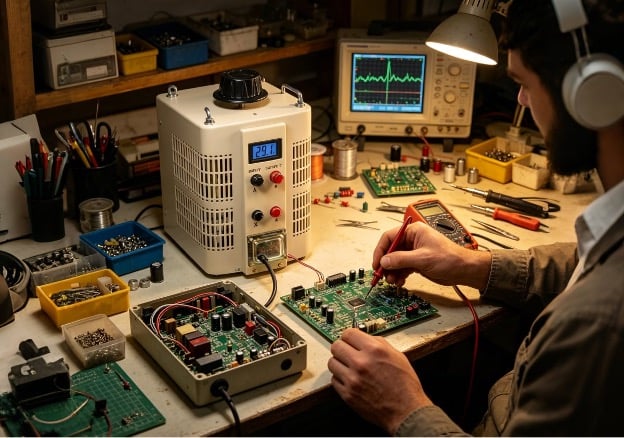
Soft-starting and component reforming (0.5 to 2 kVA): This is the most common bench use. When repairing vintage electronics or powering up a freshly populated PCB for the first time, you bring voltage up gradually from a low output voltage rather than jumping straight to full mains. This lets old capacitors reform safely and gives you a chance to watch current draw before something overheats or fails outright. It also gives you a natural pause point: if current climbs faster than expected, you can stop and inspect before any damage occurs, rather than finding out after the fact.
Voltage tolerance and brownout testing (3 to 15 kVA): Here the goal is different. You are checking how a device handles unstable power. By manually raising and lowering the voltage, you can confirm the low-voltage startup limits of a switched-mode power supply, or verify that protection relays trip correctly when input voltage drops. This range also covers general validation testing on industrial power supplies and control systems. It is useful groundwork before a device ever reaches a customer site where grid quality cannot be guaranteed.
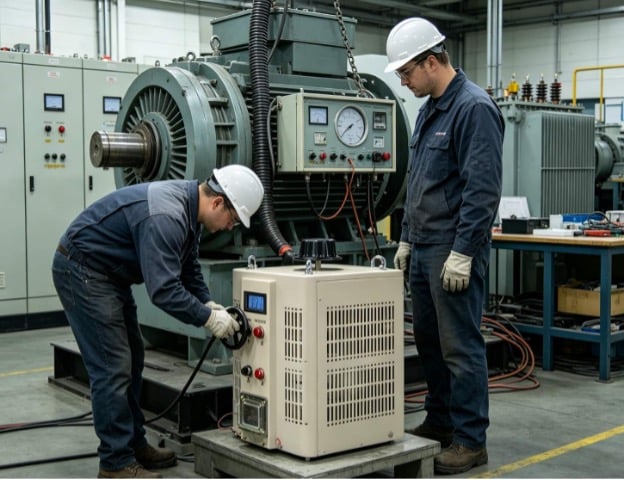
Larger equipment commissioning (15 to 60 kVA): Larger three-phase variac transformers extend this same controlled-voltage approach to industrial equipment, motors, and specialized test systems, letting technicians ramp up heavier loads without a hard start. The principle is identical to the benchtop case; only the scale changes.
Bench Safety Protocols
A few habits keep variac transformer use safe on any bench.
Because a variac transformer can output higher current at lower voltage settings, appropriate overcurrent protection should be installed according to the system design. This is easy to overlook, since it feels counterintuitive that lower voltage can mean higher current draw.
Use a fully enclosed unit with solid chassis grounding, so there is no risk of accidental contact with exposed windings. Open-frame designs are common in older units still in service, and they deserve extra caution.
Inspect the carbon brush regularly. A worn or dirty brush can arc under load, which shortens the life of the unit and introduces noise into your test. A quick visual check before a test session catches most brush issues before they become a problem.
Label the dial, or note the correlation between dial position and output voltage, on any unit that gets shared across a team. A mislabeled or unfamiliar dial is a common cause of accidental overvoltage on a shared bench.
None of these steps take long, but skipping them is how a safe tool becomes a hazard.
Sizing and Selection Guide
Choosing the right variac transformer starts with knowing your load, then leaving margin above it. A good rule of thumb is to pick a unit rated comfortably above your expected draw, so you are not running it at full capacity continuously. That margin protects against heat buildup and absorbs inrush current spikes without stressing the transformer.
To see how this works in practice, we can look at how the PowerHome range is engineered. We typically divide these units into three operational tiers based on the bench or lab environment:
| Capacity Range | Typical Use |
| 0.5 – 3 kVA | Electronics benches, audio gear restoration, individual device troubleshooting |
| 5 – 15 kVA | R&D labs, industrial electronics validation, small motor testing |
| 20 – 60 kVA | Manufacturing lines, industrial test systems, multi-phase equipment commissioning |
If your load sits between two ranges, size up rather than down. A slightly oversized variac transformer costs little extra and gives you room to grow into new test requirements, and it runs cooler at your typical load than a unit sized to the exact number on paper.
Conclusion
The variac transformer is not an outdated tool sitting in a corner of the lab. It is a straightforward, reliable way to bring equipment up to voltage safely, whether that is a single prototype board or a full industrial system. For applications ranging from precision electronics repair benches to high-capacity industrial test systems, choosing a reliable, industrial-grade variable autotransformer keeps your workshop protected during critical testing phases.