
Anatomy of Computer Fans
Other Types of Bearings
Contents
The ball bearing ring is a sealed hardware piece with small metallic balls inside (see Figure 9). Although open ball bearing rings do exist, they are not used in computer fans. This is the same kind of bearing used on roller blades and skate boards, for example.
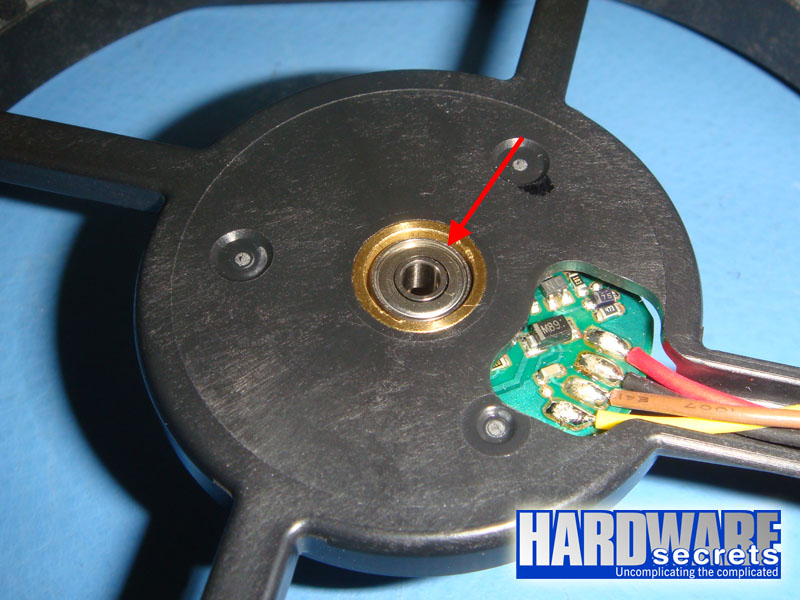
Figure 9: The ball bearing ring
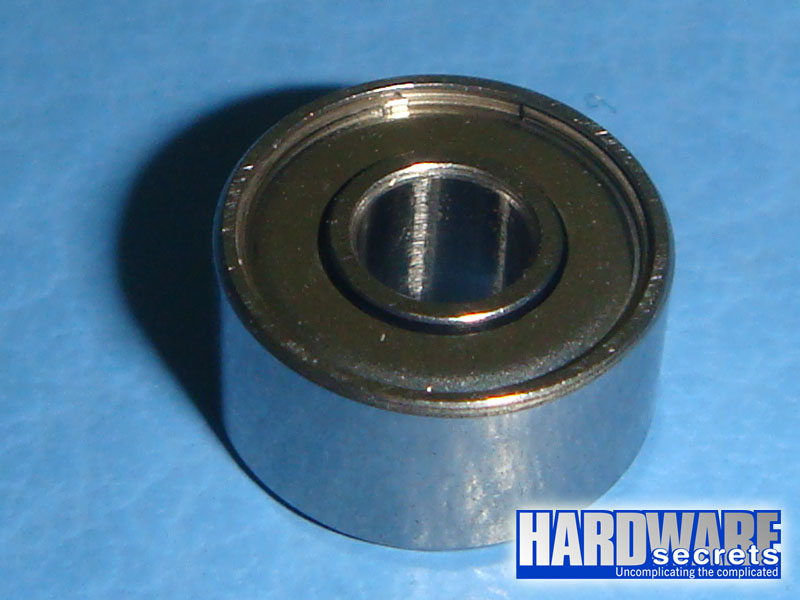
Figure 10: The ball bearing ring
Since it is a closed component, the lubricating material (usually grease) present inside evaporates at a slower pace compared to the sleeve bearing, making fans based on this component last longer. For example, at 50° C the expected life-span of a sleeve-bearing fan is 40,000 hours, while the life-span of a ball-bearing fan under the same temperature is 63,000 hours, 57% longer!
As with sleeve bearings, the life-span of ball-bearing fans depends on the temperature, as seen in the table below (source: WILLIAMS, Melody. Ball vs sleeve: a comparison in bearing performance. Chatsworth, NMB Technologies Corporation). Most fan manufacturers, however, rate ball-bearing fans with an expected life-span of 50,000 hours at 40° C.
| Temperature | Expected Life-Span |
| 25° C | 95,000 hours |
| 40° C | 75,000 hours |
| 50° C | 63,000 hours |
| 60° C | 54,000 hours |
Ball-bearing fans can be noisier than sleeve-bearing fans when both are new, but, as explained in the previous page, as they age, the noise level produced by sleeve-bearing fans increases and they become noisier than ball-bearing models.
Some fans can use two ball bearing rings instead of just one; they are called dual ball-bearing fans or 2BB (“two ball bearings”). In this case a bearing is placed at each side of the stator. Fans that use only one ball bearing are also known as 1B1S (“one ball and one sleeve bearings”), because, while a ball bearing is used at one side of the stator, on the other side, a sleeve bearing is still used to hold the shaft in place.
As opposed to sleeve-bearing fans, they can be mounted vertically or horizontally, since the lubricating material is locked inside the bearing.
As you may have guessed, fans with one ball bearing are more expensive than sleeve bearing fans, while fans with two ball bearings are more expensive than fans with one ball bearing.