Anatomy of Computer Fans
The Ball Bearing
Contents
Now that you know how computer fans work, let’s examine the component that is the source of a lot of doubts, the bearing.
The bearing is the component that allows the rotor shaft to spin, the point of contact between the rotor and the stator. It is located exactly in the middle of the stator, as already shown in Figure 4.
The type of bearing used will tell us basically two parameters, the amount of noise produced by the fan and its expected life-span.
There are two basic kinds of bearings available: sleeve bearings and ball bearings.
The sleeve bearing is the most basic kind of bearing available. It is basically a lubricated tube where the rotor shaft will be inserted in.
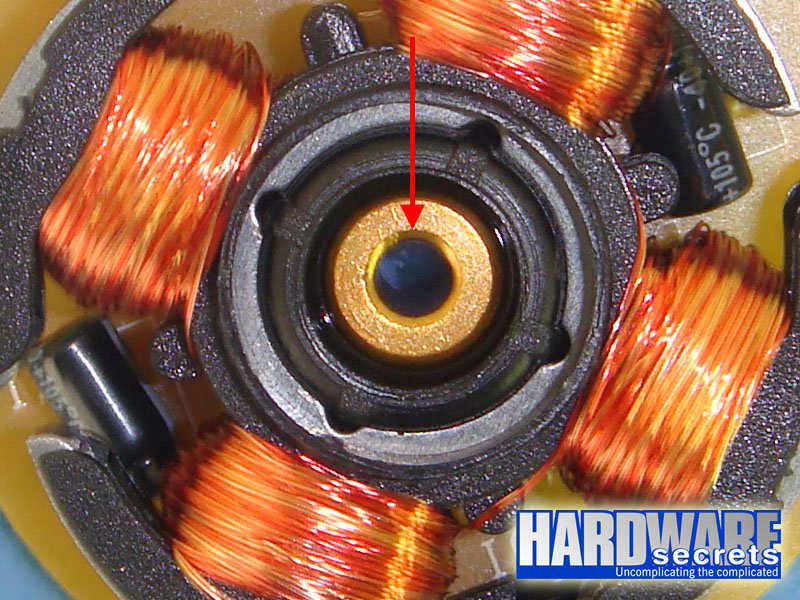
Figure 8: Sleeve bearing
People say that fans using sleeve bearing are quieter than ball-bearing fans, but this is only partially true. When the fan is brand new, this is true. But as the fan ages and the oil or grease that is available inside the tube starts drying up, this kind of fan starts getting noisier than ball-bearing fans.
The drying up of the lubricant (oil or grease) is an inevitable process and when there is not enough lubricant inside the tube, the fan will fail. Because of that, sleeve-bearing fans have the lowest life-span among computer fans. On the other hand, they are the most inexpensive type of fan.
It is important to understand that the life-span depends on the operating temperature of the fan, since with increase in temperature, the lubricant tends to evaporate faster.
Below we show a table with the expected life-span of sleeve-bearing fans depending on the room temperature (source: WILLIAMS, Melody. Ball vs sleeve: a comparison in bearing performance. Chatsworth, NMB Technologies Corporation). Most manufacturers, however, rate sleeve-bearing fans with an expected life-span of 30,000 hours at 40° C.
| Temperature | Expected Life-Span |
| 25° C | 80,000 hours |
| 40° C | 52,000 hours |
| 50° C | 40,000 hours |
| 60°C | 30,000 hours |
A drawback observed in sleeve-bearing fans is that they are not designed to be mounted withe shaft horizontal, because by installing it horizontally, the oil inside the tube will all go to one of the sides of the shaft. Therefore for best performance, sleeve-bearing fans must be mounted with the shaft vertical so the oil inside the bearing is always spread more or less evenly. Unfortunately most power supply and case manufacturers don’t follow this recommendation, which can decrease the fan life-span.